
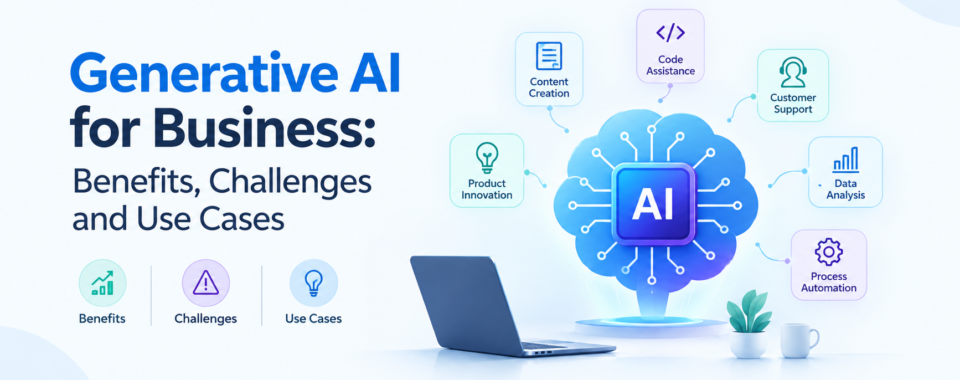
Business processes are rapidly transforming. Whether it is customer service or marketing,
from finance to sales, from human resources to software development, artificial intelligence
has found its application in all of them. The latest and probably one of the most significant
advancements in this sphere is generative AI for business, which lets organisations generate
content, process information, automate processes, and assist people- which was hard to do
using classic software tools.
According to McKinsey’s State of AI report analysed by AmplifAI, 71% of organisations
regularly use generative AI in at least one business function, while 88% of businesses report
utilising AI technologies broadly across operations. Furthermore, a Master of Code survey
highlights that enterprise adoption is directly driving financial returns, with organisations
reporting an average 24.69% increase in overall productivity and a 15.7% reduction in
operational costs. These figures show why developing a structured AI Integration Roadmap is
becoming essential for business growth and operational scaling.
But what exactly can generative AI offer companies, how can they benefit from these
benefits, and what factors should they consider before attempting to scale their usage of such
AI-based solutions?
What is Generative AI for Business?
Generative AI is simply artificial intelligence that is able to create content based on given
instructions and information input to it. The content created includes text, images, code,
summaries, presentations, ideas, responses, and other kinds of content.
In the context of generative AI for business, it is applied in the professional and
organisational environment rather than for general and recreational uses. Businesses can
benefit from the integration of AI in their processes and workflow in order to boost
productivity, enhance customer experience and decision-making, and increase efficiency.
However, the application of generative AI for business mustn't mean automation of
everything. Some of the activities require human skills such as judgment, empathy,
accountability, and expertise in a certain industry.
Benefits of Generative AI for Business
1. Increased Employee Productivity
Productivity is one of the most compelling drivers for companies to consider generative AI
for business.
Imagine a typical day in the life of an office worker. He or she may spend hours upon hours
writing emails, creating reports, summarising meetings, performing Internet research,
developing presentations, and responding to routine questions.
Using a generative AI system will greatly reduce the amount of time needed to perform many
of these tasks. For example, say an employee is given a set of notes from a business meeting
to summarise. He or she could give this task to the AI to perform for them, including:
A summary of the meeting
Major decisions
Action items
Responsibility for each action item
An email follow-up
An update on the project
2. Faster Content Creation
Businesses have been saturated by content. Virtually every function requires some type of
content. Marketing develops its campaigns. Sales generates its proposals. HR produces
content for communicating with employees. Customer service writes its responses. The
leadership develops its presentations.
This is yet another case where generative AI for business can make a difference.
AI can help you come up with ideas, develop drafts, write, rewrite, summarise long texts,
come up with variations, and adapt messages for different audiences. For example, a
marketing team could take one long article about a product and use AI to help them create
other materials such as
Social media posts,
Emails,
AD copies,
Video scripts,
FAQs,
3. Improved Customer Experience
Consumers seek convenience and personalisation of experience. Thus, customer service is
one of the most practical examples of generative AI for business. Generative AI may help
support representatives summarise the conversation, understand the consumer’s intentions,
find information and compose answers.
Let's consider an example when the consumer contacts the organisation after a few previous
interactions. Instead of scanning the whole conversation, the support representative will
receive a summary of the problem and previous actions of the consumer prepared by the AI
assistant. After that, the representative can deal with the problem. Additionally, AI may be
used for self-service to help consumers to find information via chatbots.
4. Reduced Operational Costs
Cost optimisation is yet another advantage. Companies always try to find ways to become
more efficient while keeping the same level of quality. With generative AI for business,
companies will be able to perform more work with no need to put in proportionally as much
manual labour. Think about a business that gets hundreds of queries from clients per month.
With AI assisting agents in preparing answers, employees may be capable of processing more
queries in the same amount of time.
5. Better Access to Business Knowledge
Big firms have a problem with knowledge. There is knowledge, but employees cannot easily
access it. Policies might be written down somewhere. Product knowledge might be scattered
in different systems. Knowledge from past projects might exist in various emails and
presentations.
Generative AI for business might help provide better knowledge experiences. AI-based
assistant within an organisation would let employees ask questions in natural language and
get responses based on the company’s knowledge base.
For example:
How do I raise a procurement request?
What are the conditions of this employee benefit program?
Provide me with a summary of the latest product documentation
Give me a comparison of this policy with the previous one
6. Improved Decision Support
Information overload is common among executives and managers. Reports, presentations,
emails, research reports, dashboards, consumer feedback, and internal communications may
complicate the identification of significant data.
Generative AI will be able to help with processing such a large amount of data. For example,
the manager will be able to use generative AI for business to summarise a lengthy report,
find trends, compare documents, or suggest questions which need to be explored further.
Use Cases of Generative AI for Business
1. Marketing
Marketing teams are among the biggest potential beneficiaries of generative AI for
business. AI can assist with:
Campaign ideation
Blog creation
Social media content
Email marketing
Product descriptions
Ad copy
SEO research
For instance, a marketing manager introducing a new product can request AI to come up with
five positioning approaches. These will be analysed in conjunction with the market research
and branding strategy.
2. Sales
Salespeople devote a lot of time to prospecting preparation, record-keeping, and follow-up
after meetings. Generative AI for business could save salespeople from all that.
Salespeople could utilise AI technology to summarise their:
Prospects
Prepare meeting briefings
Write personalised emails
Summarise phone conversations
Send follow-up emails
Keep account information organised.
In the case of a sales meeting, for instance, the notes could be transformed into a follow-up
email by using AI. Then, the salesperson would be able to personalise it according to the
actual content of the conversation.
3. Customer Service
Customer support is one of the clearest applications of generative AI for business.
Support teams can use AI to:
Summarise customer conversations
Draft responses
Categorise requests
Identify customer intent
Recommend relevant information
Translate customer messages
Prepare case notes
Support agent training
For businesses handling large customer volumes, even small improvements in response time
can create meaningful operational benefits.
4. Human Resources
The HR department handles quite a bit of communication and paperwork.
Generative AI can be used to:
Develop job descriptions
Interview questions
Onboarding materials
Training content
Policy statements
Communications.
An HR department could also use generative AI to develop a knowledge assistant to assist
employees in understanding company policies and processes.
5. Software Development
Another significant domain in which generative AI for business is being applied is software
development.
Software developers can leverage AI technology to help them:
Write code
Debug programs
Document applications
Test software
Explain their code
Perform other tedious coding activities
The developer can specify what functionality they want to see in their program and let AI
generate it. Then the developer can analyse the code, test it, detect security risks and make
required modifications. This would help the developer to work faster, and at the same time,
leave complicated architectural decisions for skilled programmers.
6. Finance
Finance teams work with large amounts of structured and unstructured information.
This creates opportunities for generative AI for business in areas such as:
Report summarisation
Document analysis
Internal communication
Financial research support
Knowledge management
7. Healthcare
There are possible uses of generative AI in administrative and data-intensive activities for
healthcare organisations.
Such applications may range from:
Documentation
Summarisation of research findings
Drafting of patient communications
Internal knowledge management
Administration support
Healthcare (a very sensitive area)
8. Legal and Compliance
Legal teams invest a lot of time in analysing documents.
Artificial intelligence may be helpful for:
Document analysis
Clause comparison
Contract analysis
Compliance review
Draft generation.
AI tools can also help compliance teams to help employees understand difficult policies.
Challenges of Generative AI for Business
The benefits are significant, but businesses should not overlook the risks.
1. Accuracy and Hallucinations
Information generated by generative AI could be misleading or even incorrect. This
phenomenon is often called an AI hallucination. Making a mistake during brainstorming is
not as problematic as making one when creating a financial report, a legal paper, designing a
medical process, or communicating with customers.
2. Data Privacy
Organisations deal with confidential information daily. Data such as customer information,
employee data, financial information, intellectual property, agreements, and strategic
planning must not be fed into AI technologies without knowledge of the related data
management techniques.
Organisations need to assess data storage, time data is saved, access control, encryption,
policies of the vendor, practices for model training, regulatory requirements and
categorisation of internal data before adopting generative AI for business.
3. Security Risks
There are new security considerations with generative AI for business. Businesses need to
think about unauthorised access, malicious prompts, sensitive information exposure,
inaccurate outputs, and inappropriate integrations with internal systems. The danger increases
when AI tools are connected to business databases and applications.
4. Intellectual Property
Businesses also have to think about intellectual property. AI content raises questions about
ownership, licensing, copyrighted material and the use of proprietary information.
5. Employee Resistance
Technology adoption is a people problem. Some workers may fear that generative AI will
take their jobs. Others may be distrustful of AI-generated outputs or feel compelled to use
new tools without sufficient training.
6. Lack of Clear ROI
Another common challenge is proving business value through generative AI for business.
Companies can become excited about AI demonstrations without knowing whether those
experiments actually improve business performance. This makes generative AI for business
a measurable business initiative rather than simply a technology experiment.
How to Implement Generative AI for Business
Successfully
To make generative AI for business a success, you should take a pragmatic, evolutionary
approach and focus on specific business problems rather than trying to solve everything at
once.
Ask yourselves questions such as:
Where do employees waste time?
Where do your customers struggle?
What are the most repetitive or manual processes?
Where is information difficult to find?
What are the processes that cause the biggest impediments to operations?
By answering these questions, you will be able to uncover the most compelling use cases for
you to consider adopting Generative AI for.
Choose the Right Use Case
Not all business processes are fit for the application of generative AI. Most common are
those processes where large amounts of information need to be created or analysed, or large
amounts of information are used by people: document processing, customer service, content
creation, knowledge extraction and similar areas.
Run a Pilot Before Scaling
Instead of deploying AI across the entire organisation, begin with a controlled pilot
programme. Compare performance before and after implementation by measuring key
business metrics, including time saved, productivity improvements, output quality, employee
adoption, customer satisfaction, error rates and operational efficiency.
Establish AI Governance
For the AI to be implemented successfully, there needs to be policies regarding such
technology. The policies need to include the following information: AI systems approved by
the organisation for employees to use about data privacy and information security, inputting
information rules and outputs needing human intervention, prohibited AI uses, and
documentation and disclosure requirements.
Train Employees Continuously
Even the most advanced artificial intelligence technologies are only as good as the people
who can use them, which underscores the need for extensive and regular training.
Businesses should design their programmes around the following areas:
Prompt-writing and optimisation
Fact-checking and output verification
Data privacy and cyber-security
Responsible and ethical usage
Practical application and business processes
Limitations and errors
Final Thoughts
Generative AI for business has the potential to disrupt a wide range of fields, from
productivity to automation to digital transformation. But its most profound impact is likely to
be seen not in the ability of firms to create text faster, but instead in their willingness to
rethink their approach to work and business.
A marketer can delegate content creation to AI and focus on the campaign. A salesperson can
reduce the amount of email and focus on the customer. A customer service agent can reduce
the amount of searching and start solving. A developer can delegate the monotonous coding
to start building bigger systems. A manager can reduce the amount of time spent on reports
and instead focus on decisions. This is the real potential of generative AI for business,
although organisations should be careful not to confuse productivity with some fundamental
business value.
To fully utilize the power of Generative Artificial Intelligence (AI) for your business’ growth. Generative AI allows you to create high quality content through automation; generate leads using intelligent systems; engage with customers more effectively. Work with Tech Funnel Solutions to develop scalable growth strategies based on data-driven decisions that will produce measurable outcomes.