

Introduction
The implicit confidence of users and devices inside the corporate network was the foundation of traditional network perimeters. However, depending on conventional perimeter defences exposes major weaknesses as cloud environments grow, hybrid workforces increase, and cyber attackers get more sophisticated.
Organisations all over the world are implementing Zero Trust Security, an IT security framework defined by NIST that mandates stringent identity verification for each person and device trying to access resources on a private network, regardless of whether they are seated inside or outside the network perimeter, in order to prevent unauthorised lateral movement and mitigate data breaches.
This thorough guide breaks down the core concepts, logical frameworks for making decisions, technology foundations, and strategic plan needed to implement Zero Trust Security across your whole organisation.
Zero Trust Security
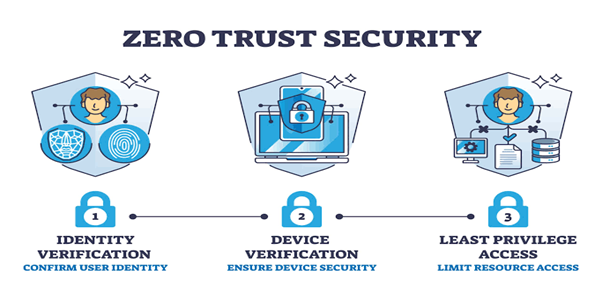
Never trust, always verify is the cornerstone of Zero Trust Security. Unlike traditional IT network security, which assumes that everything within a corporate firewall is secure, the Zero Trust Security paradigm considers all internal users, network traffic, and endpoints as potential threats.
Once an attacker gets beyond the outer firewall in a classic perimeter architecture, they frequently have unrestricted access to roam laterally across inside networks. Zero Trust Security, on the other hand, imposes dynamic policy checks and ongoing authorisation at every stage. No user or machine is given implicit trust under this architecture based only on physical location, network topology, or possession of a device provided by the company.
PDP vs PEP: How Zero Trust Architecture Works
Zero Trust Security
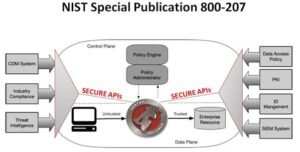
The Policy Decision Point (PDP) – The Control Plane
The main source of intelligence is the PDP. Before making an approve or deny decision, it compares incoming access requests to contextual security signals. The PDP is separated into two smaller parts by NIST:
- The Policy Engine (PE): is the ultimate decision-maker. The PE employs a dynamic trust algorithm that evaluates real-time data, such as user credentials, device health, location, time of day, and threat intelligence, to compute a confidence score and decide whether to grant, deny, or revoke access.
- The Policy Administrator (PA): is the operational executor. The PA creates session-specific credentials or tokens and instructs the Policy Enforcement Point to open or close the communication connection once the PE makes a decision.
The Policy Enforcement Point (PEP) – The Data Plane
Sitting right in front of enterprise resources (applications, workloads, or databases), the PEP serves as a non-bypassable gatekeeper.
- Traffic mediation: The process of intercepting all communication between the target resource and the requestor (subject).
- Command Execution: Gets direct instructions from the Policy Administrator to either instantly terminate active connections if risk levels change or grant temporary, encrypted application tunnels.
- Zero Direct Exposure: Ensures that no person or device can interact with a target asset without previous explicit PDP authorisation by concealing internal resources from public discovery.
Key Data Inputs Supporting the PDP (Policy Information Points)
The Policy Engine continuously consumes telemetry from external business security technologies in order to make dynamic, real-time access decisions:
|
Signal Source |
Function in PDP Decision-Making |
|
Identity Management (IAM/SSO) |
Confirms subject identity, role-based privileges, and MFA status. |
|
Continuous Diagnostics and Mitigation (CDM / EDR) |
Assesses device posture, patch status, and endpoint threat levels. |
|
Threat Intelligence and SIEM |
Feeds active vulnerability alerts, IP reputation, and behavioural anomalies (UEBA). |
|
Data Access Policies |
Defines baseline rules regarding who can access specific classification levels. |
7 Zero Trust Security Principles
The fundamental change in architectural philosophy required to deploy Zero Trust Security is governed by a number of non-negotiable criteria outlined in the CISA Zero Trust Maturity Model.
- Continuous Verification and Authentication: The Zero Trust Security methodology keeps an eye on user IDs, device posture, and session context all the time. At every access point, access is reevaluated; it is never granted once.
- Principle of Least Privilege (PoLP): Users and applications are granted only the lowest amount of access necessary to do their assigned duties.
- Microsegmentation: Networks are split up into discrete security zones. Malicious actors must pass security checkpoints at each segment boundary as a result of effective network microsegmentation, which stops lateral network movement.
- Multi-Factor Authentication (MFA): Before allowing users to access sensitive data, identity validation in Zero Trust Security requires reliable, phishing-resistant MFA solutions.
- Assuming Breach: Companies that use Zero Trust Security construct their systems under the presumption that network adversaries already exist. Security teams utilise comprehensive telemetry analysis, proactive monitoring, and end-to-end encryption to swiftly remove threats.
- Extending Non-Human Identities: Non-human identities are strictly subject to zero trust, just as human users. Lateral assaults frequently target service accounts, automated scripts, cloud workloads, and API connections since they have enhanced access. Compromised microservices cannot compromise core databases by enforcing rigorous API-to-API least privilege, secret management, and short-lived token authentication.
Zero Trust Use Cases
A. Modernising Remote Access (Replacing Legacy VPNs)
Problem: Once authorised, traditional VPNs provide extensive internal network access, giving hackers with stolen credentials unrestricted access.
Zero Trust Solution: By connecting users directly to specific programmes via ZTNA (Zero Trust Network Access) rather than the underlying network, the Zero Trust Solution conceals all illegal resources.
B. Controlling Third-Party, Vendor, and Contractor Risk
Problem: Using unmanaged, high-risk devices, external contractors frequently require access to internal equipment.
Zero Trust Solution: Enforces agentless, web-based access restrictions with strict device posture checks, giving users temporary access to just necessary systems without exposing them to the network.
Core Technologies and Essential Pillars Supporting Zero Trust Security
Achieving a robust Zero Trust Security architecture involves combining several distinct security technologies mapped across the CISA Zero Trust Maturity Model pillars:
|
Pillar / Technology |
Primary Role in Zero Trust Security |
Key Value Delivered |
|
Identity and Access Management (IAM) |
Uses RBAC, SSO, and MFA to confirm identity
|
Uses Zero Trust Security identification checks to guarantee that only validated entities can access systems
|
|
Zero Trust Network Access (ZTNA) |
Gives access at the application level |
Prevents widespread network exposure by concealing apps from public view |
|
Microsegmentation |
Separates network zones and workloads |
Stops lateral threat migration in accordance with Zero Trust Security guidelines |
|
Endpoint Detection and Response (EDR) |
Continually checks the posture and health of the device |
Guarantees that hacked devices are unable to access vital databases |
|
Security Information and Event Management (SIEM) |
Telemetry, threat analytics, and real-time logging |
Gives all Zero Trust Security setups consolidated visibility |
|
Data Loss Prevention (DLP) and Encryption |
Sensitive assets are categorised, tagged, and encrypted while they are in use, in transit, and at rest |
Maintains data integrity even in the event of a network segment or endpoint breach |
|
Behavioural Analytics (UEBA) |
It continuously assesses user and entity activity for risk anomalies |
Detects mass data exfiltration, impossible travel, and active session hijacking |
Benefits of Zero Trust Security for Business and Security
Moving to zero trust security has major operational and defensive advantages for modern businesses:
- Reduced Blast Radius of Data Breach: Zero Trust Security uses microsegmentation and least-privilege access to isolate compromised accounts or systems.
- Enhanced Visibility in On-Premises and Cloud Environments: Multi-cloud infrastructure often results in operational blind spots. Zero Trust Security ensures continuous logging as well as centralised enforcement of policies across distributed settings.
- Simplified Regulatory Compliance: Strict data handling and accessibility governance are emphasised by regulations like GDPR, HIPAA, and PCI-DSS. Zero Trust Security’s built-in automated access controls make auditing and compliance validation easier.
- Smooth Support for Remote and Hybrid Workforces: Legacy VPNs frequently give too broad network permissions and falter under high traffic. No matter where employees log in, secure, direct access to particular corporate applications is enabled by replacing legacy tunnels with Zero Trust Network Access solutions.
A Strategic Plan for Putting Zero Trust Security into Practice
An organised, staged deployment strategy is necessary for an organisation to make the switch to Zero Trust Security:
- Determine Sensitive Data and Critical Assets: Determine which corporate applications, hardware assets, critical infrastructure, and sensitive data flows need to be protected under Zero Trust Security.
- Map Transaction Flows: To establish efficient access baseline policies for Zero Trust Security, comprehend how lawful traffic moves between users, apps, and networks.
- Create Zero Trust Networks: By implementing software-defined perimeters and microsegments that impose stringent access restrictions based on the operating procedures of your company.
- Enforce Identity Control and Posture Checks: All Zero Trust Security endpoints must have corporate single sign-on, authentication using multiple factors, and current device posture verification.
- Monitor, Analyse, and Iterate: You may progressively improve your organisation’s Zero Trust Security architecture by regularly monitoring access logs, examining privilege distributions, and utilising automated analytics.
Overcoming Typical Implementation Difficulties
Businesses frequently encounter challenges when putting Zero Trust Security into practise, despite its many advantages:
- Integration of Legacy Systems: Older apps might not support more modern authentication techniques like SAML or OIDC. Organisations using Zero Trust Security often utilise proxy wrappers or identity-aware gateways to protect outdated infrastructure.
- User Friction: If set up incorrectly, frequent verification prompts might interfere with productivity. Zero Trust Security runs covertly in the background during trusted sessions when seamless context-aware policies are designed.
- Policy Complexity: While lax regulations decrease efficacy, too aggressive permissions have the potential to keep off legitimate users. For Zero Trust Security to be successful over time, balanced, dynamic policies must be maintained.
Current News and Industry Updates
By the middle of 2026, Zero Trust will be an operational necessity rather than just an architectural suggestion. Over 70% of organisations globally have formally adopted Zero Trust programmes thanks in large part to legislative frameworks like the EU’s NIS2 Directive and DORA (Digital Operational Resilience Act), according to Gartner. The implementation of Zero Trust in settings with limited Operational Technology (OT) and essential infrastructure was specifically addressed in updated recommendations published by CISA and its government partners in important policy advancements. This strategy offers a practical bridge from theoretical models to operational resilience in the real world by highlighting compensating measures, phishing-resistant MFA, and passive surveillance for legacy systems where normal IT agents cannot be installed.
Conclusion
Adopting Zero Trust Security is not a one-time product upgrade but rather a deliberate, continuous evolution in an organisation’s approach to risk, identity, and access. By distinguishing security from actual network perimeters as well as ensuring real-time policy evaluation with both human users and non-human workloads, organisations can significantly decrease their attack surface, isolate the lateral threat movement, and protect essential assets across multi-cloud environments.
As cyber threats continue to operate at machine speed, setting up a well-planned Zero Trust structure backed by dynamic Policy Decision Points, robust microsegmentation, and strict data-centric controls ensures that your organisation upholds a secure, compliant, and future-ready digital defence posture.
Prepare Your Business for the Future, Now.
It’s clear Zero Trust will shape the future of business and business technology. But it’s impact goes even deeper. Organizations employing Zero Trust methodologies gain the edge in assuring the safety and security of their data, and in turn, better enabling the business to cultivate growth opportunities.
The team at TechFunnel Solutions is passionate about driving innovative, data first strategies, allowing organizations to flourish in this competitive market.