
A new stage of commercial adoption of artificial intelligence is underway. Organisations are increasingly utilising systems that can comprehend objectives, analyse information, leverage business applications, make judgements, and carry out several phases within a workflow, rather than merely employing AI to create content, respond to enquiries, or automate isolated jobs. In 2026, this change will place AI agents in the enterprise at the forefront of digital transformation and business automation.
Adoption is happening on a large scale. Just 1% of businesses believe they are fully AI-mature, despite 92% of them planning to boost AI spending over the next three years. Meanwhile, 66% of businesses claim quantifiable increases in productivity, and 79% of businesses use AI agents to some extent. These enterprise AI adoption statistics for 2026 demonstrate how rapidly investment is rising even as companies continue to develop the procedures and infrastructure required to properly grow AI.
Additionally, a variety of business functions are using the technology. Customer service, sales and marketing, finance, human resources, legal operations, supply chain and logistics, healthcare, manufacturing, data access, and cross-system workflow orchestration are all using AI agents in the enterprise. The variety of enterprise AI-agent applications shows how the technology is expanding into entire business processes rather than just specific activities.
The basic shift is straightforward: businesses are now asking what AI can do rather than what it can create.
AI Agents in the Enterprise
AI agents in the enterprise are intelligent software programmes created to accomplish particular goals by comprehending context, evaluating data, organising actions, communicating with linked systems, and carrying out tasks with little assistance from humans.
Conventional automation often adheres to predetermined guidelines. An AI agent is capable of handling evolving data and figuring out what needs to be done to get a certain result. For instance, an AI agent can assess a lead, look at available customer data, tailor communications, set up a follow-up, update the CRM, and suggest what should happen next instead of automatically sending the same email each time a lead enters a CRM. AI agents are capable of carrying out multi-step business procedures and comprehending context.
What sets AI Agents in the Enterprise apart from traditional chatbots and simple process automation is their capacity to integrate reasoning, information, tools, and actions.
Important Use Cases for AI Agents in Business
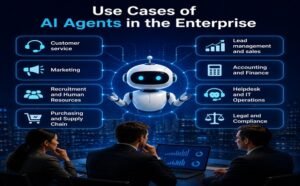 1. Customer service
Because support teams handle a lot of recurring requests, customer service is one of the best uses for AI agents in the enterprise. In addition to tracking orders, retrieving customer information, answering common questions, triaging tickets, and providing contextual answers, agents can also escalate complex instances to human representatives. While human agents can concentrate on complicated issues and conversations that call for empathy or judgement, workflows where agents retrieve information from systems like CRM platforms, order management systems, and knowledge bases are linked to a 60–80% decrease in ordinary ticket handling time.
The benefits of AI agents for enterprises go beyond quicker reactions. Employees don’t have to constantly look for information or move clients between departments because agents can keep context throughout multiple stages of a contact.
2. Lead management and sales
Sales teams devote a significant amount of time to lead qualification, CRM record updating, meeting scheduling, communication preparation, and client data review. A large portion of this administrative work can be automated by AI agents in the enterprise.
Inbound leads can be analysed, engagement signals can be assessed, prospects who meet predetermined criteria can be found, outreach can be customised, follow-ups can be scheduled, and records can be updated. The potential for agents to handle repetitious sales administration is demonstrated by the 40% increase in sales time spent with customers observed by sales professionals adopting these processes.
3. Marketing
Another domain where AI agents in the enterprise might link many operations is marketing. Content production, audience analysis, campaign reporting, customised email sequences, competitor research, trend detection, and campaign optimisation are all areas in which agents can assist. An agent can compile pertinent data and carry out predetermined activities, saving marketers from having to manually compile information from several platforms.
The connection between analysis and execution provides the wider benefit. A marketing agent can recognise a trend, assess its applicability to a certain target, create content, disseminate it via a workflow that has been approved, and track the reaction.
4. Accounting and Finance
High numbers of invoices, transactions, financial documentation, reconciliations, compliance obligations, and reporting are handled by finance departments. Invoice reconciliation, fraud detection, loan-risk assessment, quote-to-cash workflows, KYC procedures, expense management, and financial forecasting are all supported by AI agents in the enterprise. Finance is one of the sectors where agent-based automation can directly affect operations since enterprise finance workflows can reduce invoice processing times by 70–90%.
Removing financial experts from the process is not the goal. Instead, while people concentrate on exceptions, analysis, planning, and judgements requiring expert judgement, agents can manage high-volume processing.
5. Recruitment and Human Resources
HR is another useful use for AI agents in the enterprise since hiring and personnel management involve a lot of repetitive tasks. Resumes are screened, candidates are selected based on predetermined criteria, interviews are scheduled, employee enquiries are addressed, onboarding is coordinated, documentation is managed, and training procedures are supported by agents.
While onboarding agents can manage tasks related to IT access, benefits, training, and documentation, organisations that use AI agents for HR operations report 50% faster time-to-hire. Agent-based solutions can reduce administrative labour throughout the employee lifecycle, as evidenced by the 50% faster time-to-hire statistic and HR workflow apps.
6. Helpdesk and IT Operations
Every day, IT professionals deal with a lot of operational data and support requests. AI agents in the enterprise can assist with ticket management, routine problem-solving, access request support, system monitoring, anomaly detection, and the coordination of authorised remedial actions. This is especially useful because information from several systems is often needed in IT workflows. Before making a recommendation or performing an action, an agent can obtain the pertinent context.
Additionally, enterprise IT is starting to play a significant role in agentic deployment. The employment of AI agents in conjunction with IT staff for operational tasks has been the focus of recent advancements in 2026, which reflects the larger trend toward AI systems that actively participate in enterprise workflows.
7. Purchasing and Supply Chain
Demand, inventory, suppliers, purchase orders, transportation, and delivery dates are all variables that supply chains rely on. Demand forecasting, inventory optimisation, supplier communication, procurement, purchase-order processing, vendor comparison, and logistics planning are all supported by AI agents in the enterprise.
When predetermined circumstances are met, agents can coordinate actions and continuously monitor information. This might lessen the amount of manual labour required to check several systems and interact with various stakeholders. Supplier monitoring, purchase-order workflows, demand forecasting, inventory optimisation, and vendor communication are examples of supply-chain, procurement, and logistics applications for AI agents.
8. Legal and Compliance
AI Agents in the enterprise can be used by legal departments for document analysis, due diligence, contract review, clause identification, compliance monitoring, and regulatory tracking. In addition to identifying potentially problematic wording, summarising pertinent information, and flagging issues for human review, an agent can compare documents to approved requirements.
Contract comparison, risky-clause identification, version monitoring, and compliance-related workflows are examples of AI-agent applications for legal contracts and compliance. When it comes to legal interpretation, responsibility, or major business implications, human assessment is still crucial.
Benefits of AI Agents in Enterprise
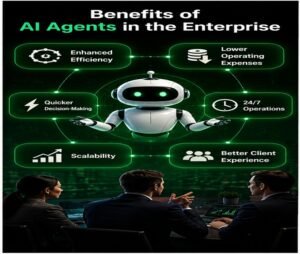
1. Enhanced Efficiency
Reducing repetitive work is one of the most obvious advantages of AI agents in the enterprise. Data entry, document processing, regular communication, information retrieval, and administrative coordination can all take up less time for staff members.
2. Lower Operating Expenses
The amount of manual labour needed to handle large amounts of work can be decreased by using AI agents in the enterprise. Organisations may manage greater workloads without adding manual labour at the same rate by automating repetitive procedures, which can also enhance resource allocation.
3. Quicker Decision-Making
Employees can obtain pertinent data without having to wait for manual reporting or information collection due to agents’ rapid retrieval and processing of information. When choices rely on data dispersed across multiple enterprise systems, this can be especially helpful.
4. 24/7 Operations
The AI agents in the enterprise are not constrained by business hours and can work around the clock. Because of this, they are helpful for tasks that require constant availability, such as workflow processing, monitoring, and customer support.
5. Scalability
Businesses can utilise AI agents in the enterprise to manage growing workloads as business volumes expand without necessitating corresponding increases in manual processing. Businesses with high transaction volumes, quick expansion, or seasonal demand may find this very helpful.
6. Better Client Experience
Service quality can be raised via quicker reactions, more individualised communication, constant availability, and improved access to client data. While human employees focus on complex situations where judgement and empathy are most important, agents can manage everyday contacts.
Challenges with AI Agents in the Enterprise
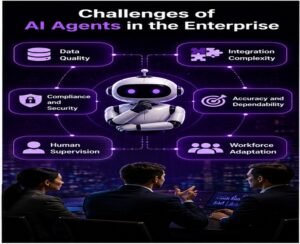
1. Data Quality
Agents rely on the data at their disposal. The quality of judgements and actions can be impacted by inaccurate, incomplete, out-of-date, or fragmented data. Data readiness must be addressed before organisations try to scale agentic workflows, as evidenced by the fact that 70% of organisations find their data infrastructure fundamentally deficient after initiating ambitious AI programmes. The significance of preparing corporate data prior to expanding AI agents in the enterprise is demonstrated by the 70% enterprise data-infrastructure finding.
2. Integration Complexity
Hundreds of programmes that were created at separate times and weren’t intended to cooperate are frequently found in enterprise technology systems. Connecting AI agents in the enterprise with current systems might become one of the most challenging aspects of implementation, as demonstrated by the 897-application and 29% interoperability rates.
3. Compliance and Security
When AI agents in the enterprise are able to access sensitive data or carry out operations inside business systems, security becomes even more crucial. Proper identity management, permissions, monitoring, audit trails, data controls, and approval procedures are necessary for businesses. When an agent is able to take high-impact acts without adequate authorisation, the risk is especially severe.
Since August 2026, this issue has gained more attention due to security talks that show how poorly managed AI agents can lead to vulnerabilities in identification and access control. Authorisation limits, least-privilege access, and stopping agents from getting beyond security measures are the main points regarding AI agents and business security.
4. Accuracy and Dependability
A user can fix an AI-generated inaccurate response. An enterprise system’s automatic mistake can have even more serious repercussions. Therefore, testing for AI agents in the enterprise must include not only response quality but also action, exception, authorisation, escalation path, and system integration dependability.
5. Human Supervision
Autonomy shouldn’t entail excluding people from all decision-making. While humans are still in charge of high-impact choices, sensitive customer instances, financial approvals, legal rulings, security actions, and other circumstances where accountability is crucial, AI agents in the enterprise can manage routine and clearly defined operations.
6. Workforce Adaptation
The use of AI agents in the enterprise alters how workers operate. Teams must be aware of what agents are capable of, when their work needs to be verified, when human intervention is necessary, and who is ultimately accountable. Therefore, automating as much as possible is not the best strategy. The goal is to reorganise workflows so that, in situations where human expertise is important, people maintain control while bots do the necessary tasks.
What Will Change in 2026 for AI Agents in Enterprises?
Interoperability, scale, governance, and execution are becoming more and more important aspects of the enterprise AI-agent ecosystem.
Agent2Agent’s transition to the Agentic AI Foundation is a significant August 2026 development. The protocol is intended to enable autonomous AI agents to find each other, share tasks, and collaborate across various frameworks and systems. The Agent2Agent interoperability upgrade on August 17, 2026, suggests that AI agents in the enterprise will eventually be able to communicate without the need for individual-specific integrations between each system.
Additionally, enterprise deployment is expanding. The scale at which businesses are starting to view personalised agents as workforce infrastructure rather than experimental tools is demonstrated by Cisco’s planned rollout of AI agents to 90,000 employees. The deployment of 90,000 employees across the enterprise demonstrates how rapidly the discussion around AI agents in the enterprise is progressing toward company-wide adoption.
New security requirements are being created concurrently with enterprise adoption. Identity and authorisation are becoming more crucial since AI agents can access systems, data, credentials, and workflows. Strong authorisation boundaries and least-privilege access are crucial, according to recent enterprise security guidelines for autonomous AI agents.
These advancements suggest a setting where AI agents in the enterprise are more than just stand-alone helpers. They are evolving into interconnected parts of larger business structures.
Conclusion
In 2026, AI agents in the enterprise will transform how businesses handle automation. Businesses can employ agents to comprehend objectives, retrieve information, coordinate systems, make judgements, and carry out multi-step processes rather than restricting AI to content creation, question answering, or isolated job automation.
AI agents in the enterprise can produce quantifiable operational value in a number of areas, including customer service, sales, marketing, finance, HR, IT, procurement, supply chain, legal operations, healthcare, manufacturing, analytics, and cross-system orchestration.
The competitive edge will come from converting agent skills into safe and long-lasting business processes as AI agents in the enterprise progress from testing to wider deployment.
Are you ready to use AI as a means of achieving business growth?
AI agents are having a transforming effect on enterprise operations, sales, and customer engagement; if companies adopt the correct strategy they will be able to discover new opportunities and increase their efficiency.
We at TechFunnel Solutions assist businesses in growing by means of data-driven B2B lead generation, ABM, and digital marketing solutions.
How can you speed up the growth of your business?
Get in touch with our team today