
Introduction
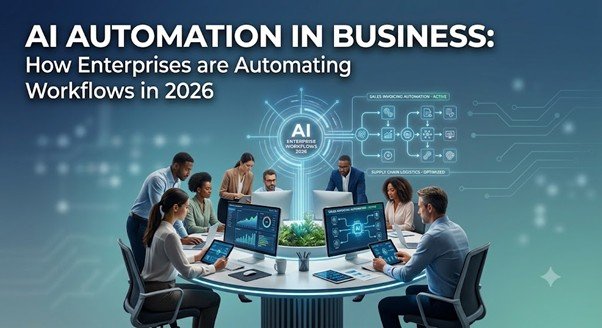
Businesses are moving into a new automation phase when artificial intelligence is employed for more than just creating content, responding to enquiries, or helping specific staff. Workflows that transfer data, make choices, initiate activities, and coordinate tasks across several systems are increasingly using AI. This move will make AI automation in business a more significant component of enterprise operations by 2026.
The figures demonstrate the rapid advancement of workflow automation. According to a recent study, 60% of firms see a return on investment from workflow automation within a year, and 78% of enterprises use AI in at least one business function. 68% of IT leaders claim that AI procedures have already changed operations.
Organisations using AI-enabled workflow automation report cost savings of 10-50% and productivity gains of 25-30% in automated operations. These numbers contribute to the explanation of why businesses are going beyond simple rule-based automation. In 2026, integrating people, apps, data, choices, and actions into a unified operational flow will be a major emphasis of AI automation in business.
This has important ramifications: businesses are shifting from asking what AI can accomplish to figuring out where it should be used in routine business operations.
AI Automation in Business
Using artificial intelligence to automate, optimise, or support business processes with less manual intervention is known as AI automation in business. Conventional automation often adheres to predetermined guidelines. The system takes a predefined action when a specific circumstance is met. Automation powered by AI provides features like information analysis, document interpretation, pattern recognition, decision assistance, and action adaptation.
Thus, an AI workflow may consist of multiple interconnected steps:
- Gathering data from business systems
- Comprehending both structured and unstructured data
- Analysing the information
- Choosing the next course of action
- Starting an automated process
- Business application updates
- Escalating employee exceptions
- Recording the results for improvement and monitoring
This is the difference between basic task automation and modern AI automation in business.
For instance, an automated workflow might receive an invoice, extract pertinent data, verify it against business rules, compare it with purchase data, find inconsistencies, forward it for approval, and update the applicable system. Only when the workflow detects an exception could an employee need to step in. This capability is being progressively expanded by AI agents. Instead of only carrying out a single predetermined action, they are able to employ linked systems, read context, coordinate several processes, and carry out tasks within predetermined parameters.
The Significance of AI Automation in Business in 2026
The shift from isolated automation to linked and intelligent workflows is the largest shift in AI automation in business. In the past, automation worked well in predictable processes. Enterprise procedures nowadays are frequently more intricate. Emails, documents, requests from customers, approvals, databases, CRM systems, ERP platforms, compliance checks, and context-dependent judgements are all involved. Automation can handle more of this complexity due to AI. AI agents are technologies that can automate repetitive processes, analyse real-time data, enhance decision-making, and link data across enterprise applications, according to recent enterprise analysis. These processes can be connected by AI automation in business, eliminating the need for human data transfers between systems.
The number of clients using its agentic AI deployments had multiplied ninefold in only nine months; this trend became even more apparent. In order to control AI agents across platforms, the business also showcased an AI Control Tower. This breakthrough highlights a significant shift in enterprise automation: businesses are starting to consider how numerous AI capabilities can function across business infrastructure while being controlled and measured, rather than just using individual AI tools.
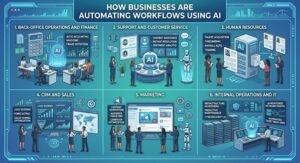
How Businesses Are Automating Workflows Using AI
 1. Back-office operations and finance
Numerous repetitive procedures, including bills, paperwork, approvals, reconciliation, expenditure management, reporting, and data validation, are found in finance departments. Through information extraction from documents, record validation, transaction matching, routing approvals, and exception identification, AI automation in business can help automate these procedures.
Financial processing, expense approvals, invoice matching, reconciliation, and compliance checks are significant uses for AI agents. The benefit goes beyond just making one work go more quickly. It is possible to link several processes together. After entering the system, an invoice’s data can be extracted, compared to pertinent records, and then routed based on the results. The workflow can proceed automatically if everything matches. The relevant personnel can be notified if there is a discrepancy. As a result, AI automation in business handles repetitive tasks while staff members concentrate on exceptions and judgement-based decisions.
2. Support and Customer Service
Because support personnel deal with a lot of repetitive queries, tickets, requests, and follow-ups, customer service is another important area for AI automation in business. AI is able to classify client requests, determine their purpose, offer preliminary answers, suggest fixes, route tickets, elevate urgent problems, and update customer information. AI-powered customer service is also being used by businesses for FAQs, ticket processing, scheduling appointments, lead gathering, multilingual help, and round-the-clock consumer engagements. This can be further enhanced via workflow automation, which links internal procedures to consumer interactions.
This can be further enhanced via workflow automation, which links internal procedures to consumer interactions. A client request, for instance, can be received, categorised, assigned to the right team, prioritised based on urgency, and automatically followed up on. Because of this, AI automation in business is beneficial for both customer communication and customer issue resolution within the business.
3. Human Resources
Repetitive tasks like onboarding, leave administration, employee notifications, attendance, approvals, paperwork, and payroll-related tasks are handled by HR personnel. Workflows with AI capabilities can gather employee data, initiate onboarding procedures, route approvals, provide reminders, and handle regular requests.
AI agents can automate repetitive HR tasks like leave management, payroll checks, and onboarding workflows. 2026 research identifies areas where AI automation in business might lessen human labour, including employee notifications, shift monitoring, attendance tracking, approvals, and compliance documentation. Therefore, AI automation in business can lessen administrative burden for HR departments while freeing up employees’ time for workforce-related tasks that call for human connection.
4. CRM and sales
Updating CRM records, recording contacts, preparing follow-ups, qualifying leads, and handling administrative duties frequently take up a significant amount of time for sales professionals. AI automation in business can link these tasks together. AI technologies can assist with call and meeting recording, CRM data updates, lead scoring, follow-up drafting, proposal generation, revenue forecasting, and deal identification.
AI-enabled workflows can collect data and initiate the subsequent step, eliminating the need for salespeople to manually transfer information between systems. The end product is a workflow that maintains connections between lead data, customer interactions, follow-ups, and sales activities.
5. Marketing
Marketing workflows are getting more automated. Content production, email marketing, customer segmentation, social media scheduling, advertising optimisation, SEO suggestions, and customised campaigns can all be helped by AI. When AI is able to react to consumer behaviour, marketing automation becomes more potent.
For instance, an AI-enabled workflow can evaluate engagement data and assist in identifying which clients should get specific messaging. Behaviour, purchase history, preferences, and interaction patterns can all be used by automated email workflows to facilitate personalisation. This advances AI automation in business to include procedures that react to evolving customer data rather than just sending prearranged messages.
6. Internal Operations and IT
Service tickets, system alerts, incident management, employee enquiries, onboarding, reporting, and system updates are all handled by IT departments. AI can assist with warning classification, pattern recognition, issue prioritisation, resolution recommendations, and request routing.
Workflow automation can lessen manual involvement in IT ticket management, automated onboarding, reporting, notifications, and data synchronisation. Removing people from IT operations is not always the goal of AI automation in business. Rather, common problems can be handled automatically while experts focus on complicated situations and choices.
AI Agents are Advancing AI Automation in Business
The rise of AI agents is one of the most significant advances in AI automation in business. AI agents can work toward a specific goal, evaluate data, use tools, communicate with systems, and coordinate several tasks, which sets them apart from traditional automation. Agents are software components that can use APIs, retrieve data, make judgments within policy constraints, and manage multi-step workflows. This is important since there is rarely a single activity in an enterprise workflow.
For instance, a purchase workflow can include determining a need, reviewing the information that is accessible, getting in touch with a system, verifying data, asking for approval, updating records, and sharing the results. Instead of requiring an individual to start each step individually, an agent-based workflow can coordinate them.
The Increasing Interoperability of AI Agents
When Google’s Agent2Agent protocol advanced toward the Agentic AI Foundation in August 2026, it was a very significant breakthrough. The protocol is intended to facilitate communication and coordination between AI agents from various platforms and providers, eliminating the need for businesses to create a unique integration for each agent. This could become crucial for businesses since large-scale AI automation will increasingly require several specialised agents rather than a single system handling every task.
If the proper standards, permissions, and governance are in place, an agent managing consumer information may be able to communicate with another in charge of finance, supply chain, human resources, or internal data. Because of this, interoperability is becoming a more crucial component of enterprise workflow architecture.
Agentic ERP: A Novel Approach to Business Automation
Enterprise resource planning is also being affected by the shift to agent-driven workflows. An Agentic ERP architecture that combines role-aligned AI agents, workflow orchestration, and human oversight to carry out end-to-end business operations on an ERP backend was presented in a July 2026 study. The constraints of conventional rule-based automation in workflows, including exceptions and cross-functional decisions, are especially addressed in the research. This is important for AI automation in business because many enterprise processes revolve around ERP systems.
An agentic ERP paradigm seeks to enable AI agents to carry out processes under specified controls and take part in operational decisions rather than just documenting transactions. A key tenet of enterprise automation is reinforced by the research’s use of a risk-tiered person-in-the-loop approach: more autonomy need not equate to the removal of human monitoring.
How Enterprises Can Get Started with AI Automation in Business
Process selection, as opposed to technology selection, is typically where a successful AI automation in business plan starts. Finding repeated, high-volume, quantitative, and well-understood workflows is the first step.
Businesses can look at:
- How often the procedure takes place
- How much time it takes up for employees
- Where delays take place
- How frequently mistakes are made
- The number of systems engaged
- Which choices call for human judgement
- What would be the operational or financial impact
Mapping the present process and identifying areas where AI can be useful is the next step.
Starting with a small pilot instead of trying to automate a full department at once is a sensible strategy. Determining if the workflow should be expanded can be aided by measuring time saved, processing speed, error rates, cost, and staff involvement.
Additionally, this method facilitates the identification of areas that still require human control. Organisations will require orchestration, integration, monitoring, security, and governance in addition to AI models as AI automation in business grows from individual workflows to interconnected corporate processes.
The Future of AI Automation in Business
End-to-end workflow orchestration is where AI automation in business is headed. Businesses are starting to link AI agents, APIs, corporate apps, data sources, workflow engines, and human approvals instead of just automating specific tasks. Agentic AI, hyperautomation, AI orchestration, API-first automation, and low-code or no-code workflow creation are the current automation trends. This evolution is further complicated by the August 2026 shift toward standardised agent communication. Businesses may be able to create workflows from specialised agents instead of relying on a single, huge system to handle every task if AI agents can communicate across platforms more readily.
At the same time, governance and security will become more crucial. Organisations cannot treat AI agents like regular software, as demonstrated by recent business security reports. Authorisation, monitoring, identity management, and least-privilege controls are crucial since agents may have access to private information, business applications, and privileged operations. Thus, the path is clear: AI automation in business is progressing from basic task automation to an enterprise operating model where AI may assist with information comprehension, workflow coordination, limited decision-making, and action execution.
Conclusion
In 2026, AI automation in business will alter how businesses handle tasks. Invoice and reconciliation procedures can be automated by finance staff. Employee requests and onboarding can be streamlined by HR departments. CRM administration can be decreased by sales teams. Routine conversations and ticket routing can be automated by customer support teams. IT departments are able to categorise problems and automate internal procedures.
However, the introduction of AI agents that can coordinate several steps across enterprise systems is a more important development. The best AI automation in business strategies will concentrate on the proper workflows, trustworthy data, quantifiable results, safe integrations, and suitable human oversight.
Therefore, 2026 will be more about figuring out which tasks should be automated, how autonomous those workflows should become, and how businesses can grow them safely than it will be about whether AI can automate work.
Turn Innovation into Business Growth
AI automation is having an impact on the way that businesses operate. If you combine intelligent strategies with focused marketing you will be able to discover new opportunities.
If you’re ready to scale, why not take a look at our services offered by TechFunnel Solutions?