
Ask five IT leaders to define hybrid cloud vs multi cloud, and you’ll probably get five different answers, three of which contradict each other. That mix-up isn’t just semantic nitpicking either. According to Flexera’s 2026 State of the Cloud Report, 73% of organizations now operate a hybrid cloud model, up three percentage points from the year before, while multi-cloud adoption keeps climbing right alongside it. The debate over hybrid cloud vs multi cloud has real consequences for budgets, compliance, and how fast your teams can actually ship.
Most companies don’t end up choosing one over the other by design. They inherit both. A merger brings in a Google Cloud footprint nobody planned for. A product team spins up its own AWS account because procurement was too slow. Before long, you’re running a patchwork of environments, and nobody on the leadership team can confidently say whether you’re “hybrid,” “multi-cloud,” or just disorganised. This guide breaks down what separates the two models, where they overlap, and what actually works when you’re managing them in production rather than on a whiteboard.
What Is Hybrid Cloud
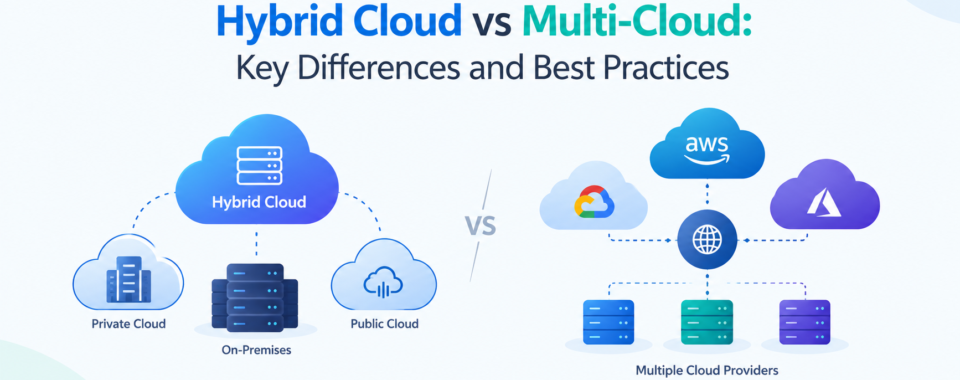
Hybrid cloud combines public cloud services with private infrastructure, whether that’s an on-premises data center or a dedicated private cloud, and ties them together so they function as one coordinated system. IBM’s own framing captures the point well: hybrid cloud is about orchestration between environments, not just having more than one of them sitting side by side.
The defining feature is integration. Workloads, data, and applications move between your private environment and the public cloud based on need. A bank might keep customer records in a private cloud for compliance reasons while running its mobile app’s compute-heavy features on AWS during peak hours. That’s hybrid cloud doing what it’s built for: giving you control where control matters and elasticity where elasticity pays off.
What Is Multi-Cloud
Multi-cloud means using two or more public cloud providers, commonly a combination of AWS, Microsoft Azure, and Google Cloud, without necessarily linking them into a single managed system. Cloudflare puts it simply: hybrid cloud blends different types of infrastructure, while multi-cloud blends different providers of the same type.
A retail company might run its e-commerce platform on AWS, its analytics pipeline on Google Cloud because BigQuery fits the use case better, and its internal productivity tools on Microsoft’s ecosystem because that’s where the Office licenses already live. In a lot of real-world multi-cloud setups, these environments barely talk to each other. Each one handles its own workload in isolation, and that’s often intentional rather than a failure of planning.
Hybrid Cloud vs Multi Cloud: The Core Difference
Here’s the cleanest way to separate the two. Hybrid cloud is about what kind of infrastructure you’re combining, public plus private. Multi-cloud is about how many vendors you’re using, regardless of whether any of them are private.
| Factor | Hybrid Cloud | Multi-Cloud |
| Core mix | Public cloud + private/on-premises | Two or more public cloud providers |
| Primary driver | Data control, compliance, latency | Vendor choice, avoiding lock-in |
| Integration | Deep orchestration, often unified management | Frequently siloed, workload-specific |
| Typical use case | Regulated industries, legacy modernization | Best-of-breed services, negotiating leverage |
| Complexity source | Networking and data sync across environments | Managing multiple consoles, billing, and skill sets |
They’re not mutually exclusive, and this is where the hybrid cloud vs multi cloud debate gets messy in practice. A company can absolutely run a hybrid cloud that also pulls in services from three different public vendors. IBM calls this combination “hybrid multi cloud,” and it’s genuinely the norm for large enterprises today rather than the exception. Flexera’s data backs this up too: organizations typically deploy or test across an average of 3.4 public clouds and 3.9 private cloud environments at once. That’s not a tidy two-box comparison. That’s sprawl, managed well or managed poorly depending on the organization
Why Organizations End Up With Both
Flexera’s 2026 report makes an interesting point that gets lost in most “hybrid cloud vs multi cloud” explainer content: a lot of multi-cloud adoption isn’t strategic at all. It’s driven by mergers, siloed application ownership, or teams making independent purchasing decisions long before anyone centralized governance. Only 14% of organizations surveyed run a pure multi-cloud setup with no private cloud in the mix, which tells you most “multi-cloud” companies are actually operating some flavor of hybrid multi cloud whether they call it that or not.
This matters for how you plan. If your multi-cloud footprint grew by accident, the fix isn’t picking a winner between hybrid cloud and multi-cloud. It’s building governance that can see across whatever you’ve already got
Best Practices for Hybrid Cloud
Map data residency requirements before you migrate anything. Know exactly which datasets are legally or contractually required to stay on-premises, then design your architecture around that constraint rather than retrofitting it later.
Invest in a single pane of glass for monitoring. Tools like Red Hat Open Shift, VMware Cloud Foundation, or native cloud management platforms let your team see private and public workloads through one dashboard instead of switching between five.
Standardize on containers early. Kubernetes-based deployment makes workloads genuinely portable between your private infrastructure and public cloud, which is the entire point of going hybrid in the first place. Skip this step and you’ll end up rebuilding applications every time you want to shift a workload.
Build your network for latency, not just bandwidth. Hybrid cloud performance problems usually trace back to poorly planned connectivity between environments, not to compute capacity. A dedicated connection like AWS Direct Connect or Azure ExpressRoute is often worth the cost.
Best Practices for Multi-Cloud
Pick providers based on workload fit, not habit. Running everything on one vendor because that’s what the team already knows defeats the purpose. Evaluate each provider’s actual strengths, GCP’s data analytics tooling, AWS’s breadth of services, Azure’s enterprise integration, against the specific job.
Centralize cost visibility from day one. Wasted cloud spend actually rose in 2026 for the first time in five years, hitting 29% according to Flexera, largely because of the added complexity from AI workloads and new service tiers. Multiple providers mean multiple billing structures, and without a unified FinOps view, waste compounds fast.
Avoid duplicating your entire stack across providers. You don’t need identical security tooling, identity management, and logging configured separately in every cloud. Use provider-agnostic tools where you can, and accept that some redundancy is the cost of avoiding lock-in.
Train your team across platforms deliberately. Multi-cloud skill gaps are one of the most underestimated costs of this strategy. An engineer fluent in AWS IAM doesn’t automatically understand Azure’s role-based access model, and assuming otherwise creates security gaps.
Which Model Fits Your Organization
If your industry is heavily regulated, healthcare, finance, government, hybrid cloud usually wins because it gives you a defensible answer to “where exactly does this data live.” If your priority is negotiating leverage and avoiding dependence on a single vendor’s roadmap, multi-cloud makes more sense. And if you’re like most mid-size and large enterprises today, you’ll end up needing both, whether that happens by deliberate design or by acquisition and organic sprawl.
The honest answer from the 2026 data is that the hybrid cloud vs multi cloud question increasingly isn’t an either-or decision at all. Flexera’s report shows 76% of large enterprises now spend more than $5 million a month on cloud services, and that scale forces a level of governance maturity that treats hybrid and multi cloud as overlapping pieces of one estate, not two competing strategies. The organizations getting the most value aren’t the ones that picked a side. They’re the ones that built visibility and cost discipline across whatever mix they ended up with.
Are you ready to put together a smarter cloud strategy?
If you are looking at a Hybrid Cloud architecture in order to gain more control or going with a Multi-Cloud approach for the reasons of flexibility and resilience, then selecting the right strategy can have a significant effect on your business performance.
When companies are investing in cloud modernization they usually pair this with strategic B2B Lead Generation Services in order to take full advantage of growth opportunities and to enhance their operational efficiency.
TechFunnel Solutions assists organizations in speeding up their digital transformation by means of data driven marketing, scalable technology solutions, and strategic business growth initiatives.
Why not speak to our experts right now to find out what’s the best approach for your business?
FAQs
What’s the simplest way to remember the difference between hybrid cloud and multi-cloud?
Hybrid cloud mixes public and private infrastructure together. Multi-cloud uses multiple public providers, whether or not private infrastructure is involved at all.
Can a company use hybrid cloud and multi-cloud at the same time?
Yes, and most large enterprises do. IBM refers to this combination as hybrid multi cloud, and it’s now the standard setup rather than an edge case.
Which is more expensive, hybrid cloud or multi-cloud?
Neither is inherently cheaper. Costs depend on workload design, but multi-cloud tends to add complexity through duplicate tooling and separate billing systems across providers.
Is multi-cloud better for avoiding vendor lock-in than hybrid cloud?
Generally yes, since multi-cloud spreads workloads across providers by design. Hybrid cloud can still reduce lock-in if the private infrastructure component is built on open, portable standards like Kubernetes.
Do small businesses need a hybrid cloud or multi-cloud strategy?
Not usually at first. Smaller teams are often better off starting with a single public cloud provider and only adding complexity once a specific compliance, performance, or cost need demands it.