
Introduction
Enterprise leaders are always under pressure to improve corporate agility, lower operational risk,
and modernise technology. However, moving to the cloud in the absence of a defined plan
frequently results in performance problems, security problems, and cost overruns. For this reason, a
clear cloud migration plan is essential to a company’s success.
A cloud migration strategy is a comprehensive plan that describes how a company may transfer its
data, applications, and infrastructure from traditional or on-premises systems to a cloud-based
environment. The more popular method is to employ a public cloud through a provider; however,
some businesses may run their own private cloud.
A technical roadmap is only one aspect of a cloud migration strategy. It is a structure that is in line
with the business. This platform guarantees the safe transfer of workloads, data, and apps to the cloud.
It does so effectively, with quantifiable results.
To minimise risk and optimise long-term value, this guide provides a detailed cloud
migration strategy for businesses.
Benefits of Cloud Migration
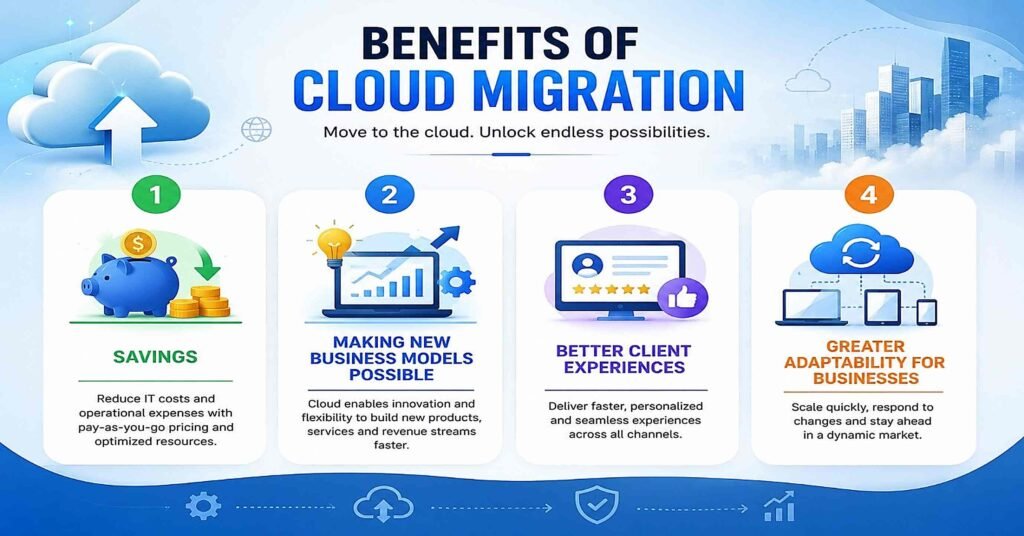
The utilisation of cloud infrastructure and services to enhance cost, innovation, experience, and
agility yields the true benefits of cloud migration.
1. Savings
- Pay for the infrastructure you utilise: Infrastructure and resources for an internally deployed
application are frequently sized to accommodate the maximum level of loading necessary. - Reduce utility and data centre expenses: Organisations can focus on the parts of their
mission-critical infrastructure that are necessary rather than needing to own the
infrastructure to support every application needed across an enterprise. - SaaS can lower administration and maintenance expenses: By outsourcing the great majority
of maintenance and management chores, using a SaaS application instead of deploying off-
the-shelf software can save money. - Focus vital resources on your core company objectives and skills: In addition to saving
money, replacing an internal application that isn’t part of your companys core business
offering or value-add with a cloud-based service (often SaaS) can free up internal technical
staff to work on other important initiatives.
2. Making new business models possible
Because cloud migration enables businesses to benefit from new business models, it is also a crucial
facilitator of digital transformation. Countless examples vary depending on the market and product
categories, but some examples are as follows:
- Manufacturers can connect directly to their supply chain using real-time AI-based
forecasting models, or they can obtain direct access to their customers without using third-
party distribution systems. - Government organisations that provide services online rather than in person or through
antiquated green-screen systems. - Retailers use cloud-based AI and analytics tools to track and recommend content based on known customer preferences.
- Integrating cloud services like accounting, CRM, and AI/ML to improve a mission-critical offering’s capabilities.
3. Better client experiences
Improving customer experience by considering user capabilities and interests is the most important
transformative change sought by certain organisations. By enabling a customised customer
experience for each user, offering quicker service, and delivering better information, cloud migration
promotes digital transformation.
4. Greater adaptability for businesses
It could take a while for new application requirements to be defined and deployed when all
applications were housed in data centres. Including the time needed to procure hardware, negotiate
and purchase underlying software licenses, integrate network and management tools, test, and
deploy, the initial implementation of even an established program from a reputable vendor with few
dependencies takes months, if not longer. Even increasing capacity can take weeks or months to
complete.
Strategies for Cloud Migration: The 6 Rs
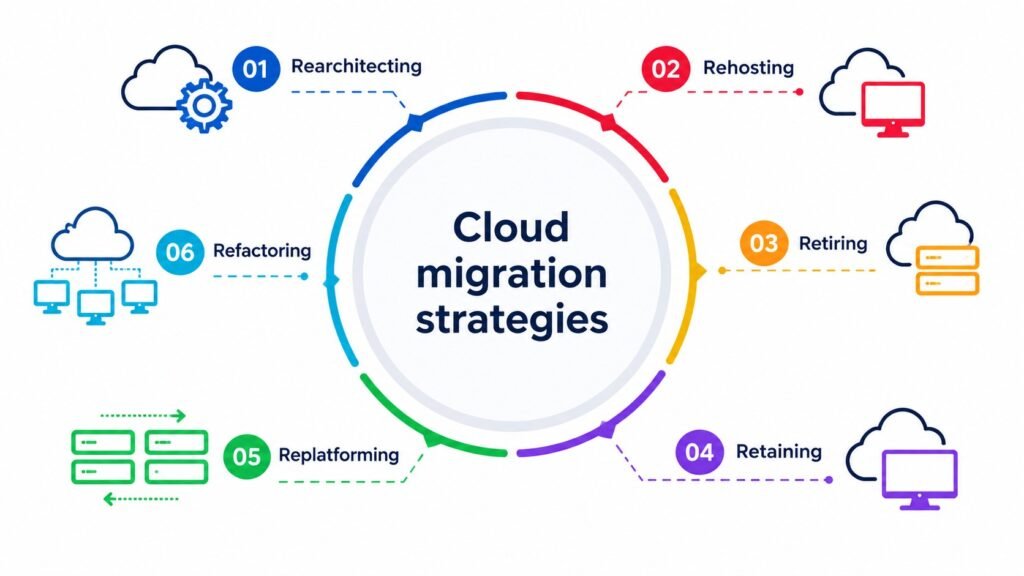
The following popular tactics, also referred to as the “6 Rs of cloud migration” (Figure), are
frequently used in cloud migration initiatives:
1. Re-hosting
Rehosting, sometimes referred to as lift and shift, entails transferring data and applications to the
cloud with little to no changes made to the systems’s functioning. Because it involves less time and
money up front, this approach is frequently selected due to its quickness and ease of use. Rehosting,
however, would not fully utilise the cloud’s built-in features, which might restrict possible cost and
performance savings.
2. Retiring
Organisations may utilise the relocation process as a chance to find and decommission out-of-date
or useless data and applications. Retiring is a method that can assist lower the expenses, complexity,
and security risks related to maintaining outdated applications. Businesses can increase productivity
and better position themselves for future expansion by concentrating on updating and optimising
their IT infrastructure.
This strategy differs from repurchasing, which occurs when a company purchases a cloud-based
service to fully replace a component or service from an application.
3. Retaining
Certain data or apps may have to stay on-site due to technological, security, or legal restrictions. The
sustaining strategy acknowledges that not all elements of an organisation’s IT environment are
suitable for cloud migration. By carefully selecting which technology to remain on-site, organisations
may decrease risks and maintain compliance.
4. Replatforming
Replatforming involves making minor adjustments to applications or infrastructure components in
order to take advantage of cloud-native features. These adjustments may be made to the database,
middleware layer, or application runtime. While still needing less work than more involved
refactoring or rearchitecting techniques, replatforming can help organisations achieve greater
performance, scalability, and cost reductions.
5. Refactoring
Refactoring involves rewriting and rearchitecting software to make the most of the clouds benefits.
Increased performance, scalability, and agility are often the results of this strategy. However,
refactoring could be time-consuming and resource-intensive. The strongest candidates for this
strategy are often those applications that are critical to the companys long-term existence or that
would significantly benefit from cloud-native capabilities.
6. Re-architecting
Re-architecting is the process of developing new cloud-native microservices and applications to
replace antiquated infrastructure. With this strategy, companies may modernise their IT
infrastructure and adopt cutting-edge technologies like serverless computing and containerisation.
Although this approach might be challenging and time-consuming, the long-term benefits in terms of
scalability, performance, and flexibility often outweigh the expense.
9 Steps for Developing a Successful Cloud Migration Strategy
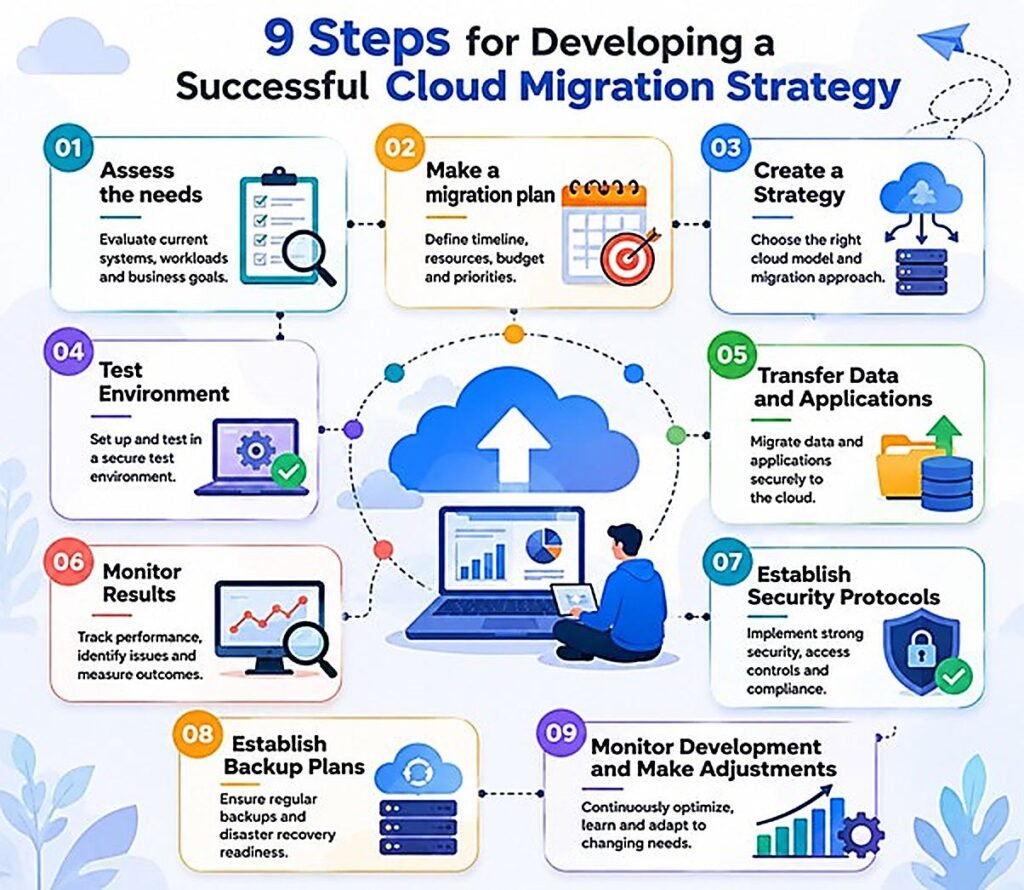
Step 1: Assess the needs
The first step in a successful on-premises to cloud migration is figuring out what kind of cloud service
best suits your needs. This involves evaluating the infrastructure, data storage needs, and current
applications used by the business. Scalability, cost, security, and other aspects should be taken into
account when making this choice.
Step 2: Make a migration plan
The next phase in the on-premises to cloud migration process is to plan the migration procedure
after the type of cloud service has been determined. This entails deciding who will be in charge of
each task and developing a schedule for each one that needs to be finished. During this stage, any
necessary modifications to current systems or processes should also be determined.
Step 3: Create a Strategy
Creating a plan for moving data and apps from the current environment to the platform of the cloud
service provider is the third stage in an effective on-premise to cloud migration. This involves
selecting the data and apps that must be moved as well as the method of doing it (e.g., using backup
software or manual operations).
Step 4: Test Environment
It is essential to thoroughly test the environment by modelling real-world circumstances before
starting the cloud migration process. Any compatibility or performance problems that may arise
during the actual migration process can be found at this point.
Step 5: Transfer Data and Applications
It’s time to start moving data and apps from the current environment to the platform of the cloud
service provider when testing is finished. Based on how much data and apps your business has, this
process could take a long time.
Enough resources must be provided for the on-premises to cloud conversion in order to guarantee a
seamless and efficient transition and remove any potential obstacles or unanticipated problems that
may arise.
Step 6: Monitor Results
It’s crucial to closely monitor performance to ensure that everything is functioning properly on the
new system after all of your data and apps have been successfully transferred from on-premises to
the cloud. Additionally, it’s imperative to consider mission-critical programmes that are essential to
the efficient operation of your business.
These programmes must always be operational, free from disruptions or unplanned downtime
brought on by hardware or software component malfunctions. This holds true for both the
environment of the remote cloud provider and your local network architecture.
Step 7: Establish Security Protocols
A seamless on-premises to cloud migration requires the establishment of robust security protocols
that shield vital corporate data from unwanted access. These protocols should strike a compromise
between providing users with the access they need for work-related tasks, such as remote login
from home and maintaining strict security standards. By using these security measures, businesses
may protect their critical data and lower the risks associated with the migration process.
Step 8: Establish Backup Plans
Strong security standards and the implementation of reliable backup systems are crucial for on-
premises to cloud migration. These backup alternatives are essential for both preventing hardware
faults and protecting against malicious attacks such as ransomware.
An organisation could be destroyed by a single attack if adequate backups aren’t in place. As a result,
having strong backup systems in place before any possible security breach or danger is essential.
Step 9: Monitor Development and Make Adjustments
Finally, after all migrations have been successfully finished and staff members have received
comprehensive training on how to utilise their new systems, it is critical to maintain an active
strategy by regularly reviewing performance data.
This entails analysing uptime and downtime percentages across predefined time intervals (such as
weekly, monthly, or quarterly) in order to make any necessary improvements. Businesses may
guarantee the continued success of their cloud migration journey by comparing these results with
the initial expectations made prior to the completion of migrations.
Train your Employees
Prioritising appropriate training for staff members on how to utilise the new system or systems after
the migrations are finished is essential to the success of an on-premise-to-cloud conversion project.
This entails making certain that workers are completely informed of any modifications that may have
occurred in their specific roles throughout the transition phase.
They should also be aware of any adjustments that must be made to their tasks in light of the
differences between the pre-migration and post-migration settings. Addressing any differences in
user interfaces between various system designs is particularly crucial.
Businesses may guarantee a smooth and seamless transition for their employees during the
relocation process by offering comprehensive training.
Conclusion
A carefully planned cloud migration strategy is essential for organisations hoping to upgrade their
operations and stay competitive in a rapidly evolving digital market. By following an organised cloud
migration architecture, understanding the six Rs, and incorporating automation into every stage,
businesses may significantly reduce risks and maximise benefits.
More significantly, success continues with optimisation, monitoring, and innovation after migration.
Here, integrating business process automation services with cloud knowledge generates long-term
benefit by expediting expansion and streamlining procedures.
When youre seeking to improve your current strategy or planning your cloud journey, working with
seasoned pros can make all the difference.
Whether you’re planning your first cloud migration or optimizing an existing cloud environment, having the right strategy and expertise makes all the difference.
TechFunnel Solutions helps enterprises accelerate digital transformation through data-driven strategies, scalable solutions, and expert consulting services designed to support long-term business growth.
Get in touch with our team today and discover how we can help your business scale smarter.
FAQs
What is a strategy for cloud migration?
A cloud migration plan is a systematic approach to moving workloads, data, and applications from
on-premises systems to cloud environments. It requires strategy, execution, and optimisation to
ensure the least amount of disruption and maximum efficiency.
How long does it take to migrate to the cloud?
Timelines for cloud migrations differ according to complexity. While enterprise-level conversions
may take many months with phased implementation, smaller migrations might just take a few
weeks.
What is a framework for cloud migration?
To guarantee successful cloud adoption, a cloud migration framework is an organised procedure that
consists of evaluation, planning, migration, testing, and optimisation.
Do cloud adoption and migration strategies differ from one another?
Indeed, shifting current workloads to the cloud is the main goal of a cloud migration strategy.
Following migration, cloud adoption entails more extensive operational, cultural, and optimisation
adjustments.