
Most enterprises are not short on data. They are short on the ability to use it. Somewhere between the sales database, the ten-year-old data warehouse, and the spreadsheets three different teams swear are “the real numbers,” decisions slow down and trust in the data erodes. That gap is exactly what data modernization is meant to close, and it has become one of the more urgent line items on the CIO’s agenda in 2026.
This guide walks through what data modernization actually means, why it matters right now, what a real data modernization strategy looks like, and how enterprises are sequencing the work without breaking the systems that keep the business running.
What Is Data Modernization?
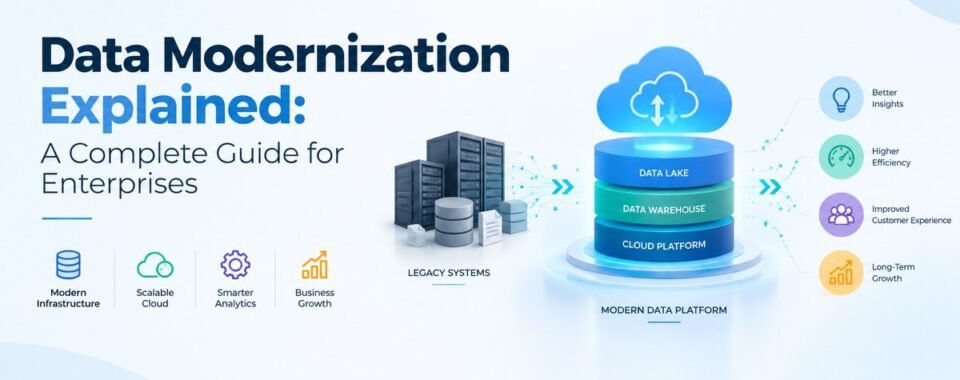
Data modernization is the process of moving an organization’s data infrastructure, meaning its databases, warehouses, pipelines, and analytics tools, off outdated, siloed, on-premise systems and onto scalable, cloud-based platforms built for today’s volume and speed of information. It is not a single migration project. It is a sustained shift in how a company collects, stores, governs, and uses data across every department.
At its core, data modernization covers four things: moving data off legacy infrastructure and into the cloud or a hybrid environment, breaking down the silos that keep finance, marketing, and operations working from different versions of the truth, replacing slow batch processing with real-time or near-real-time pipelines, and putting governance and security in place so the data can actually be trusted. Done well, data modernization turns data from a maintenance burden into something the business can act on the same day it’s generated, not three weeks later in a monthly report.
Why Enterprises Can’t Put This Off Anymore
For years, data modernization sat in the “someday” bucket of IT roadmaps. That has changed. McKinsey’s research on enterprise technology found that as much as 70 percent of the software running Fortune 500 companies was built more than 20 years ago, and much of the data infrastructure underneath it hasn’t fared any better. Systems built for a different era of business simply weren’t designed for the volume, variety, and speed of data enterprises deal with now.
Three forces are pushing data modernization from a nice-to-have to a board-level priority.
AI needs a foundation it can trust. Every enterprise AI initiative, from forecasting models to customer-facing chatbots, depends on clean, accessible, well-governed data. Feed a model fragmented or inconsistent data and it won’t just underperform, it will actively produce wrong answers with total confidence. This is arguably the single biggest driver of data modernization budgets today.
Legacy systems are getting more expensive to keep alive. Worldwide IT spending is projected to reach $6.37 trillion in 2026, a 14.2 percent jump from the year before, according to Gartner, with a growing share going toward infrastructure that supports modern, AI-ready workloads rather than patching what already exists. Meanwhile, the cost of simply maintaining aging systems keeps climbing, often without adding any new capability.
Real-time decisions are now the baseline expectation. Customers expect instant personalization, fraud teams need to flag suspicious transactions in seconds, and operations teams need dashboards that reflect what’s happening right now, not what happened last Tuesday. Batch-only systems can’t deliver that, no matter how much hardware you throw at them.
Research from data modernization specialists backs this up in practical terms too. Forty-six percent of technology leaders cite better decision-making as their top objective for modernization, 41 percent point to poor data quality as their biggest daily frustration, and 40 percent are now prioritizing AI use cases as a core business driver. These aren’t abstract goals. They’re the day-to-day reasons IT and data teams are finally getting budget approved.
Signs Your Organization Needs Data Modernization
You probably don’t need a formal audit to know if this applies to you. A few patterns tend to show up again and again in enterprises that are overdue for a data modernization push.
- Reports take days to compile because data has to be pulled manually from multiple disconnected systems.
- Different departments report different numbers for the same metric, and nobody fully trusts the dashboard anymore.
- Engineering time goes toward keeping legacy pipelines from breaking rather than building new capabilities.
- AI or advanced analytics projects stall out because the underlying data isn’t clean, complete, or accessible enough to use.
- Compliance and security reviews turn into fire drills because nobody has a full picture of where sensitive data actually lives.
If two or three of these sound familiar, data modernization isn’t a future project. It’s already overdue.
The Core Pillars of a Data Modernization Strategy
A serious data modernization effort touches more than just where the data physically sits. There are five pillars worth planning around.
1. Cloud and Infrastructure Migration
This is the part most people picture first: moving on-premise databases and warehouses to cloud or hybrid environments. Platforms like Snowflake, Databricks, and Microsoft Fabric have become common landing spots because they scale on demand and separate storage from compute, which keeps costs proportional to actual usage instead of fixed hardware limits.
2. Architecture: From Warehouses to Lakehouses
Traditional data warehouses handle structured data well but struggle with the unstructured content, think documents, images, logs, and audio, that modern AI workloads need. The lakehouse model, now supported by every major cloud provider, combines the structure and performance of a warehouse with the flexibility of a data lake, letting teams work with both types of data in one place instead of maintaining two separate systems.
3. Governance and Data Quality
Modernizing infrastructure without fixing governance just moves the mess to a nicer-looking platform. This pillar covers data cataloging, lineage tracking, access controls, and quality monitoring, the unglamorous work that determines whether people actually trust the numbers they’re looking at.
4. Real-Time and Streaming Pipelines
Replacing batch jobs that run once a night with streaming pipelines (built on tools like Apache Kafka, for example) lets data move through the organization as it’s created. This is what makes fraud detection, dynamic pricing, and live operational dashboards possible.
5. AI Readiness
This is the newest pillar, and increasingly the one driving the whole initiative. It means structuring data so it can be embedded, indexed, and retrieved for AI applications, building “data products” that are pre-cleaned and ready for AI teams to use, and cutting out the manual data-wrangling that used to eat up most of a data scientist’s week.
Common Challenges Enterprises Run Into
Data modernization rarely fails because the technology doesn’t work. It fails because of everything around the technology.
Budget is usually the first obstacle. Full enterprise-wide modernization, spanning cloud migration, governance, real-time pipelines, and AI readiness, typically takes two to five years when done in phases, and it’s hard to get multi-year funding approved without early proof of value. That’s why the most successful programs start with a narrow, high-impact use case, prove it works within three to six months, and use that momentum to fund the next phase.
Talent is the second obstacle. Teams that know both the old systems and the new platforms are rare, and legacy skills like COBOL are becoming harder to find as those engineers retire. Skipping proper knowledge transfer during migration is one of the fastest ways to end up with a modern platform nobody fully understands.
Data quality is the third, and probably the most underestimated. Migrating messy, duplicated, or poorly governed data to a shiny new cloud platform doesn’t fix the mess. It just makes the mess faster and more expensive to maintain. Cleaning and validating data before or during migration takes real discipline, and it’s the step most likely to get rushed under deadline pressure during a data modernization push.
Vendor selection trips up plenty of enterprises too. Hundreds of consultancies now offer data modernization services, but experience with your specific industry’s compliance requirements matters far more than a generic “we do it all” pitch.
A Practical Roadmap for Enterprise Data Modernization
- Assess what you actually have. Map every data source, platform, and pipeline currently in use. Flag duplicate, stale, or unused data assets before you build anything new on top of them.
- Define the target architecture. Decide on cloud platforms, integration patterns, and a governance model that fits your industry’s compliance requirements, not just the trendiest stack.
- Pick a starting domain, not the whole company. Choose one business area, customer analytics or supply chain, for example, where a win will be visible and measurable within months.
- Build the foundation in parallel with quick wins. Stand up core cloud infrastructure while delivering that first use case, so the team is building trust and infrastructure at the same time.
- Layer in governance and real-time capability. Once the foundation holds, extend into streaming pipelines and formal data governance across more of the business.
- Expand domain by domain. Use the credibility from early wins to fund and scope the next phase, rather than trying to modernize everything simultaneously.
What Enterprises Actually Get Out of It
The payoff from data modernization tends to show up in a few concrete places. McKinsey’s analysis of large financial institutions found that banks taking a comprehensive approach to legacy modernization, covering the data stack alongside core systems, cut typical transformation timelines in half and costs by roughly 70 percent compared to piecemeal efforts. Infrastructure costs drop because pay-as-you-go cloud models replace fixed licensing and hardware refresh cycles. Query performance improves enough that analysts stop waiting minutes for reports that should take seconds. Decision cycles shrink because leadership is working from one trusted version of the numbers instead of three competing spreadsheets. And AI initiatives that were previously stuck in pilot purgatory finally have data clean enough to actually deploy against.
None of this happens overnight, and no vendor pitch should promise otherwise. But enterprises that treat data modernization as a phased, business-led program, not a one-time IT project, are the ones seeing these results compound year over year rather than stalling out after the first migration.
Getting Started
Data modernization isn’t really about chasing the newest platform or the latest acronym. It’s about giving the business a version of its own data that people can actually trust and act on quickly. Start with an honest inventory of what’s slowing your teams down today, pick one domain where fixing that would matter, and build outward from a proven win instead of a five-year master plan nobody can see the end of.
Ready to turn data into business growth?
Data modernization enables companies to make better decisions, simplify their operations, and discover new opportunities for growth. At TechFunnel Solutions we help businesses to grow by means of data-driven B2B lead generation, ABM, and digital marketing solutions.
Get in touch with our team right now to discuss some new opportunities.
Frequently Asked Questions
What is the difference between data modernization and digital transformation?
Digital transformation is the broader shift in how a business uses technology across products, operations, and customer experience. Data modernization is the specific piece of that work focused on infrastructure, quality, and accessibility of data.
How long does enterprise data modernization take?
A focused initiative targeting one domain can show results in three to six months. Full enterprise-wide modernization typically runs two to five years across phases.
Is data modernization only about moving to the cloud?
No. Cloud migration is one part of it. Governance, real-time pipelines, data quality, and AI readiness matter just as much as where the data physically sits.
What industries need data modernization the most right now?
Financial services, healthcare, and retail tend to feel the most pressure, mainly due to compliance demands, legacy mainframe dependence, and the volume of real-time data they need to process.
Do smaller enterprises need data modernization too, or just large corporations?
Any organization dealing with growing data volume, multiple disconnected systems, or stalled AI initiatives can benefit, regardless of size. Smaller enterprises often have an advantage since their systems are usually less entrenched.