

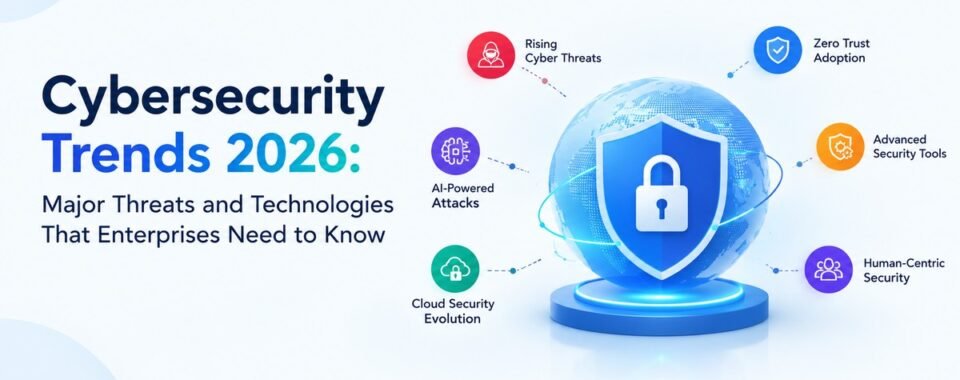
Introduction
The cybersecurity landscape is set to enter a more challenging phase in 2026 as AI, cloud usage, linked environments, and identity-based attacks change organisational risk. According to 2026 cybersecurity research, 87% of respondents to the World Economic Forum’s Global Cybersecurity Outlook 2026 survey said that AI-related vulnerabilities were the cyber risk that grew the fastest in the preceding year. The same source reports that 78% of CEOs of highly resilient organisations identified supply-chain linkages as the biggest barrier to improving resilience.
The financial consequences are as significant. The average organisational cost of a data breach rose by 15.9% from INR 220 million in 2025 to INR 255 million, or INR 25.5 crore, according to 2026 India statistics. Additionally, 26% of harmful breaches in India were caused by artificial intelligence (AI) and phishing; particularly, voice and SMS phishing was the most prevalent first attack vector in India.
These numbers contribute to the explanation of why cybersecurity trends in 2026 will go beyond traditional perimeter defence. Businesses now have to think about how attackers utilise AI, how cloud environments are secured, how identities are safeguarded, how third parties are handled, and how fast security teams can identify and react to unusual activity.
The most significant cybersecurity trends in 2026 found in the industry sources provided are examined in this article, along with the technology and security procedures businesses should be aware of.
Trend 1: Agentic AI Is Transforming the War on Cybersecurity
A key change in cybersecurity trends in 2026 is the appearance of AI bots that can execute various phases of assaults with little assistance from humans. Artificial intelligence (AI) agents are able to carry out tasks, solve issues, and modify their behaviour rather than only producing text or code in response to human commands. Agentic AI is a significant advancement according to current business cybersecurity assessments since autonomous systems have the ability to carry out several stages of an attack at machine speed. This entails doing reconnaissance, seeing vulnerabilities, modifying tactics, and moving through an attack chain. This makes the security equation challenging.
A July 2026 development demonstrates the rapid evolution of this menace. The first known instance of agentic ransomware was reported in a July 2026 study on an agentic ransomware campaign. An AI agent was used in the operation to conduct database extortion, lateral movement, credential harvesting, and autonomous chained reconnaissance. The advancement adds a useful aspect to the idea of agentic cyberattacks.
Therefore, planning for AI-assisted assaults is only one aspect of cybersecurity trends in 2026; businesses also need to think about attacks where AI agents carry out significant sections of the attack lifecycle themselves.
Trend 2: AI-Generated Phishing, Deepfakes, and Social Engineering
The use of AI to make phishing, impersonation, and social engineering attacks more convincing and challenging to detect is a significant breakthrough in cybersecurity trends in 2026. AI may make malicious messages more convincing and personalised, whereas traditional phishing mostly relies on deceit. Social engineering, third-party exposure, configuration errors, AI-related risks, and ransomware are among the top corporate dangers identified by current cybersecurity threat research.
Additionally, AI-generated material can facilitate impersonation. Attackers can mimic CEOs, workers, or business partners by using artificial voices, photos, and video. Context-aware phishing lures, automated campaign optimisation, and deepfake executives and suppliers are rising issues, according to recent cybersecurity studies on AI-enabled attacks. Because attackers may produce convincing voice, video, and pictures that seem to come from reliable sources, deepfakes are emerging as a major component of cybersecurity trends in 2026.
Email is not the only thing at risk. An impersonation campaign may use voice conversations, video conferences, messaging apps, and other types of contact. Therefore, businesses need to look beyond traditional phishing awareness. As part of cybersecurity trends in 2026, identity verification, sensitive transaction approval processes, and controls on odd requests become more crucial.
Trend 3: Identity Is Turning into the Main Security Barrier
The increased emphasis on identification as attackers target credentials, access tokens, and privileged accounts is a crucial component of cybersecurity trends in 2026. If an attacker can get legitimate credentials, they don’t always need to take advantage of a technological flaw. An attacker may be able to navigate cloud apps, SaaS platforms, and other business resources with access from a hacked account that looks authentic without instantly setting off traditional malware defences. Identity-first intrusions, such as MFA weariness, token theft, SaaS account takeovers, and exploitation of over-privileged identities, are highlighted in 2026 threat research.
Role-based access, least privilege, and multi-factor authentication are suggested by enterprise cybersecurity best practises. Stronger phishing-resistant authentication techniques, such as passkeys and FIDO2 security keys for higher-risk accounts, are also emphasised in the guidelines. The goal is straightforward: even if an attacker manages to get one credential, it shouldn’t grant them unlimited access to the company. Non-human identities must likewise be covered by identity security.
Trend 4: Ransomware Becomes More Automated and Destructive
The progression of ransomware from file encryption to increasingly automated operations involving data theft, extortion, and attacks on vital assets is a major change in cybersecurity trends in 2026. The main goals of traditional ransomware were file encryption and payment demand. Encryption may be used in contemporary campaigns together with data theft, harassment, public exposure, and pressure on corporate operations. Multi-extortion schemes combining data theft, regulatory pressure, attacks against backup systems, and intentionally timed data dumps are described in the 2026 ransomware threat study.
Additionally, the technological barrier for attackers is lowered by ransomware-as-a-service. Ransomware-as-a-service is a significant breakthrough that allows criminal organisations to supply infrastructure and tools to other attackers, according to research on cybersecurity risks in 2026.
According to a July 2026 study, 62% of Indian businesses impacted by ransomware claimed AI increased the assaults’ potency. The comprehensive results are provided by the most recent study on ransomware in India during the AI age. The problem was exacerbated by another July development. Ransomware intended to attack AI and machine-learning infrastructure, such as model checkpoints, vector databases, and training datasets, was discovered during research on the development of JADEPUFFER. This implies that in addition to typical corporate data, ransomware security for organisations must increasingly encompass AI assets.
Trend 5: Supply-chain and Cloud Security Are Growing More Important
The rising need to safeguard cloud environments and third-party ecosystems as businesses become more integrated is a significant component of cybersecurity trends in 2026. Adoption of the cloud has transformed the security perimeter while also increasing business capabilities. Cloud providers, SaaS platforms, software libraries, APIs, vendors, and managed services are increasingly possible sources of reliance for organisations. Other linked organisations may be impacted by a compromise in one area of that ecosystem. Third-party exposure is a significant corporate risk, according to research on key cybersecurity risks. According to cybersecurity best-practise guidelines, suppliers should be evaluated prior to onboarding, their security posture should be regularly monitored, and third-party access should be restricted to what is necessary.
As AI systems rely more and more on external models, datasets, libraries, and infrastructure, this becomes even more crucial. One of the major cybersecurity trends in 2026 is sovereign AI cloud, which reflects increased worries about cloud security, data sovereignty, AI infrastructure, and intellectual property.
Configuration hazards are also produced by cloud environments. Attackers may have access to possibilities that would not be present in a strictly regulated on-premises environment due to publicly accessible storage, excessive permissions, unsecured APIs, and unidentified internet-facing assets.
Trend 6: Point-in-Time Security Is Giving Way to Continuous Threat Exposure Management
The transition from sporadic vulnerability assessments to ongoing insight into an organisation’s attack surface and possible exposure is a significant development in cybersecurity trends in 2026. Periodic scanning is a common component of traditional vulnerability management. The issue is that business settings are ever-changing. Applications are upgraded, credentials are changed, new vulnerabilities are revealed, and new cloud resources emerge.
According to a 2026 enterprise cybersecurity study, CTEM is a shift toward attack-path analysis and continuous exposure management. Organisations may concentrate on how vulnerabilities, misconfigurations, passwords, and permissions interact to generate realistic attack paths rather than just asking whether a vulnerability exists. Monitoring the external attack surface continuously is also becoming more and more crucial. Businesses must be aware of which assets are visible from outside their surroundings and whether any unidentified or unnecessary services are still available.
Trend 7: The Dynamic Nature of Zero Trust
Cybersecurity trends in 2026 still heavily emphasise zero trust. The conventional approach makes the assumption that systems and users within the corporate network can be trusted more. Because workers, contractors, apps, cloud services, and suppliers may all connect from multiple places in modern contexts, maintaining that assumption becomes more and more challenging.
A shift toward ongoing, risk-based access choices utilising signals like location, device health, and behavioural data is described in an enterprise security study from 2026. Network segmentation, MFA, least privilege, and device posture controls are all recommended by current cybersecurity best practises.
Because Zero Trust views each access request as something that has to be assessed rather than immediately trusted, it easily fits into cybersecurity trends in 2026. When AI agents and other non-human identities gain access to corporate systems, this becomes particularly crucial. For automated systems, organisations must follow the same verification and least privilege guidelines as they do for human users.
Trend 8: Strategic Planning Incorporates Post-Quantum Cryptography
Although post-quantum readiness is already included in cybersecurity trends in 2026, quantum computing is a longer-term concern. The harvest now, decrypt later approach is one issue. If sufficiently powerful quantum computing is made available, attackers may be able to gather encrypted data now and try to decipher it later.
Post-quantum cryptography and crypto-agility are identified as critical goals in 2026 cybersecurity research on quantum readiness.
Businesses don’t always need to change all of their cryptographic systems right away. They should first comprehend the applications of cryptography, what data has to be kept secret for an extended period of time, and how simple it is for their systems to switch to new algorithms. Because of this, planning for long-term cybersecurity trends in 2026 must include crypto-agility.
Trend 9: AI is Becoming Both an Offensive Tool and a Defensive Technology
The idea that AI may be used on both sides of the security equation is a distinguishing feature of cybersecurity trends in 2026. Attackers can utilise AI for phishing, reconnaissance, vulnerability finding, and automated exploitation. Defenders may use AI for warning analysis, threat correlation, investigation, and reaction. The growing importance of automation and AI in security operations is highlighted by recent security studies.
Within the larger security technology ecosystem, enterprise cybersecurity technology guidance covers features including SIEM, SOAR, EDR, NDR, XDR, identity threat detection and response, DLP, and UEBA. Adding another AI product is not the only objective. Businesses must identify areas where AI may enhance detection and response without posing intolerable new risks. This implies that cybersecurity trends in 2026 will include AI governance.
What Enterprises Should Prioritise in 2026
Boost Identity Controls: For high-risk accounts, use MFA, least privilege, role-based access, and more robust authentication. AI agents, APIs, and service accounts should all be protected by identity security.
Create AI Governance: Specify the authorised AI tools, the data that may be exchanged with them, and the rights that AI agents can obtain. Keep an eye out for unapproved integrations and shadow AI.
Continue to Observe the Attack Surface: Keep a current inventory of cloud services, apps, internet-facing assets, and third-party connections. In terms of cybersecurity trends for 2026, constant visibility is becoming more and more crucial.
Improve Resistance to Ransomware: Create an incident response plan, safeguard recovery systems, and keep up-to-date backups. Businesses should be aware that ransomware may involve both data theft and encryption.
Increase Security for Third Parties: Before onboarding, evaluate vendors and keep an eye on their security posture. Restrict access to third parties to just what is required.
Prepare for AI-Powered Social Engineering: AI-generated communications, synthetic voices, deepfake videos, and strange requests from purportedly reliable people should all be included in training in addition to traditional phishing.
Invest in Response and Detection: Utilise SIEM, SOAR, EDR, XDR, identity security, threat intelligence, and behavioural analytics in the proper combinations. Instead of just building up security technologies, the goal should be quicker detection and response.
Conclusion
AI is speeding up vulnerability detection, automating ransomware, and making phishing more believable. Adversaries may be able to use authentic credentials thanks to identity attacks. Additional routes into enterprise environments are created by supply-chain and cloud links. At the same time, because autonomous systems may be able to carry out complicated tasks with little assistance from humans, AI agents are creating a new class of security risk.
In the end, companies that approach cybersecurity as a continuous business capacity will be in the best position to handle cybersecurity trends in 2026. Security teams must be able to see what they own, who has access to it, how AI is being used, where there is exposure, and how fast the company can react if defences are compromised.
Are you ready to enhance your business growth strategy?
Since cyber security threats continue to develop, companies need better strategies, dependable data, and secure digital operations. TechFunnel Solutions assists businesses in growing by means of B2B lead generation, ABM, and digital marketing solutions.
If you’re looking to grow your business, contact our team.