
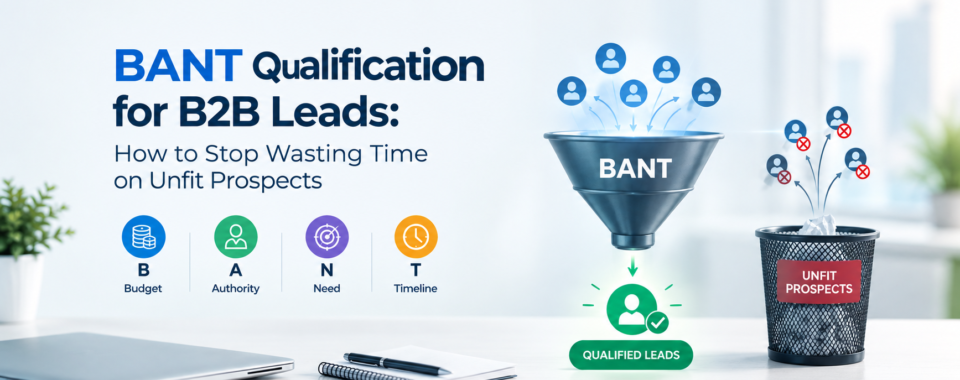
There’s nothing worse than putting 45 minutes into a discovery call, shipping out an elaborate proposal, and sending follow-ups to the ends of the earth… only to hear crickets. Turns out your prospect was never even in the market. A good BANT qualification process is the most valuable B2B sales process you can implement to shut this down, protect your pipeline, and align your team on qualified leads that can close. Let’s unpack BANT, what other teams are doing wrong with it, and how to implement it as a scalable lead gen strategy.
What Is BANT Qualification for B2B Leads?
BANT – that’s right, the acronym for Budget, Authority, Need, and Timeline – was actually invented by IBM way back in the 50s to internally assess where reps were spending their time and which leads were most valuable. And here we are decades later, and it’s still one of the most common lead qualification methods in B2B. And for good reasons.
Here’s what each element means in practice:
1) Budget: Do you have money? (Like, right now, allocated funds for this kind of purchase). Or are you talking to someone with, “Yeah, I could make a budget for that.”
2) Authority: Do you have the decision-maker? (Someone with the check-writing pen or ability). Or are you talking to an influencer who needs buy-off from some other people higher up the food chain? (I’m talking to a VP/CFO/Committee)
3) Need: Do you have a real, painful business problem for them? (Are they really hurting from something your product or service can solve) Or are you just doing research?
4) Time: When are you buying this? Next 30 days? Next quarter? “Someday?”
Your real “sales-ready” lead will rank high in all four metrics. A lead that only scores 1 or 2 is someone to work with (a nurturing lead, not someone your A/E on your right should talk to today).
What You’re Losing By NOT Implementing BANT In Sales
The majority of B2B sales reps and companies alike have no clue how expensive chasing unqualified leads can be. We’re talking more than just wasted time on pointless follow-up calls. No, I’m talking about the potential loss in every qualified lead that wasn’t able to be contacted because your team member was busy going down a well-endowed dead-end with a prospect that would NEVER buy in a million years.
You might be surprised to know that research by HubSpot shows that your sales team is only actively selling about 34% of the time. The rest of that time is administrative, research-driven, and (low-value) outreach. Multiply that by your lost lead opportunity cost, and it quickly becomes clear that you’re actually losing money every single time someone on your team falls prey to an unqualified lead.
What are the signs that your sales team is wasting their valuable time on the wrong people?
- Long sales cycles ending with no decision.
- Followed by complete radio silence once a proposal is sent.
- Stalled deals that never move from the approval phase because your point of contact wasn’t empowered to make the final decision.
- Late in the game, ‘no budget’ responses (this could mean your prospect didn’t confirm they had a budget at the beginning of your discovery phase).
BANT has got your back on all of these. It ensures these issues are addressed from the jump and saves resources from being spent on a deal before there’s any real commitment on either side.
How to Use BANT Qualification in Your Sales Process
Most teams make the mistake of just checking BANT off a list at the top of the call. That feels like an interrogation of a prospect. Instead, naturally weave in the BANT questions as you’re having a discovery call.
So how do we navigate each of these pillars?
- Budget. Please avoid asking about their budget within the first two minutes, as it can make things awkward.
Instead, open the budget conversation through a value lens.
Some examples of what to ask include:
- “Many of our clients in your sector usually invest anywhere from X to Y dollars to get \[outcome]. Does that sound like something you’re considering?”
- “Have we put a budget aside to address this problem, or is this something that’s still on the drawing board?”
- “If we’re able to identify the perfect solution for you today, is there a realistic path to getting it approved by the end of this quarter?”
The aim here is to figure out if there’s a reason to have a budget discussion at all at this moment, and whether their budget is more or less in the same league as our price range.
- Authority. B2B purchases are rarely a solo affair – unless you’re buying a new printer, perhaps!
In many cases, between six and ten stakeholders can be involved in a decision, according to Gartner’s research into B2B buying behavior.
While your contact may be a super-champion for your cause, it doesn’t always mean they have the final word.
Examples of authority questions:
- “Typically, who else is involved in the process when your organization makes these kinds of investments?”
- “Is there anyone from finance or upper management who needs to sign off on this decision?”
- “Have you bought solutions like this in the past? What did that look like for you?”
Even if you’re dealing with a gatekeeper or influencer, don’t walk away entirely. Just be sure to ask that they introduce the true decision-maker in your next follow-up conversation. It’s extremely rare for a deal where you never connect with the ultimate budget-holder to close.
- Need. Here’s where a lot of salespeople make a critical error: they confirm a vague “problem,” and then they’re off to the races with their sales pitch.
Stop!
Take a deep dive into the details of the pain.
Some examples of what you can ask include:
- “How long has this issue been a problem for your team?”
- “What has been done to solve it already? What went wrong with those approaches?”
- “What do you envision will happen to your company if this challenge isn’t addressed in the next six months?”
This last question is gold. If your prospect has a hard time quantifying the consequences, the problem might not be urgent enough to warrant a purchase. The higher the priority of the need, the greater the impact.
- Timeline. Just because someone is interested in your solution doesn’t necessarily mean they want it today. “We’re looking at this for next year” is a very different ballgame from “we need to get something implemented before Q4,” so be sure not to mix these two up, or you’ll find yourself wasting valuable effort.
Here are a few good timeline questions to have in your arsenal:
- “Is there a particular date or milestone that’s driving this decision?”
- “What needs to happen on your side to keep things on track to move forward within the next 30 to 60 days?”
- “Are there any other initiatives or priorities in your business that might put this project on the back burner?”
Knowing someone doesn’t have time pressure is good to know. That’s not someone in your pipeline; that’s someone in your nurturing track. That’s not a lost deal, it’s saving your team time from people not yet ready.
How to Use BANT Qualification at Scale in B2B Lead Generation?
Implementing BANT qualification for b2b leads Effectively:
Getting BANT Qualification for your Lead Generation at scale.
So, if your B2B company is looking to scale, BANT can’t be just a part of what’s buzzing around in your SDRs’ heads. Instead, you should bake it into your entire lead generation and lead handoff process. It ensures that the leads passing your gate to Sales are already filtered and meet your BANT requirements.
Here are 3 ways to bring this into practice:
- Integrate BANT into your CRM
You can simply add new mandatory BANT fields within your CRM, like Budget range, Buying authority (Champion/Decision Maker/Influencer), Confirmed need(Y/Partial/N), and the Target timeline. No lead should transition to an SQL stage without these details being filled out.
- Use your content to prequalify
If you put up gates for certain pieces of your content, such as ROI calculators, pricing comparison sheets, or specific solutions case studies, it attracts prospects that are farther down the buyer journey. When someone downloads your pricing sheet, they have implicitly acknowledged budget awareness and their need for a solution – a much hotter lead compared to an empty white paper download.
- Hire a BANT-specialized lead generation partner
If you’re looking for volume in lead generation, whether it is via demand generation, account-based marketing, or content syndication. A specialist partner delivering BANT pre-qualified leads can really reduce the time spent by your reps on unqualified leads. Techfunnel Solutions offers BANT lead generation services with verified prospects, already passed the BANT qualification checks before the lead hits your desk.
BANT in Multi-Stakeholder Engagements
If you are in enterprise B2B, chances are you are selling to a buying committee, not to a single buyer. In these cases, you need to qualify against multiple people, not just the contact you have connected with first.
Try creating a BANT matrix where you simply map every individual you interact with against the criteria: Maybe your champion holds budget authority for technology, but the CFO holds the purse strings and doesn’t feel the urgency, as they are not in the trenches. By understanding the gaps, you can create account-specific outreach for each individual: Financial proof for a skeptical CFO, R.O.I. Worksheets for a budget owner, data sheets for end-users, and so on… this is exactly where Account-Based Marketing and BANT qualify.
Typical BANT Blunders That Are Killing Your B2B Teams’ Pipeline
BANTing like a Detective. It feels like you’re grilling a prospect when you come right out and pepper them with four BANT questions in your very first meeting. Interweave the BANT criteria throughout a discovery call – spread it out over multiple touchpoints.
Think of the budget as Black and White. Rarely is there no budget – or a 100% approved budget. Opportunities usually involve the existence of off-budget spending, discretionary spending, or opportunities where buying can happen in phases. Try to identify those opportunities before you prematurely disqualify the prospect on budget.
Not Taking No for an Answer – Sort of. Many B2B salespeople continue with a sale even if the point of contact doesn’t have the authority because they feel like they can get executive approval down the line. This usually creates a mid/late stage stall. Get your multi-threading dialed in earlier.
Overdoing the BANT framework for Inbound. When inbound prospects are raising their hand via content consumption, webinars, or demos, you already have a degree of “want” there. By having too much BANT friction early on, you risk turning off prospects who simply require more nurturing. Match the degree of friction you apply to the source of the lead.
BANT qualification in a nutshell: FAQs
First things first: What is this whole BANT thing in B2B?
BANT is short for Budget, Authority, Need, and Timeline. Basically, it’s your checklist for figuring out if someone is worth your team’s precious time and sales effort before you go all in. It helps you determine if a lead is actually a good fit for what you’re selling.
- Still BANT-y in 2026?
Totally. I know B2B buying is getting trickier. Bigger decision-making bodies, way longer sales cycles… the works.
But BANT still holds up as the bedrock qualification process.
Smart teams aren’t necessarily using it in a single ‘qualification call’ anymore; they’re spreading those questions across multiple touchpoints and stakeholders to paint the full picture.
- So how’s this different from, say, CHAMP or MEDDIC?
All three frameworks aim to answer the same questions: Is this lead qualified? But they come at it from different angles. BANT is the no-fuss, everyday guy.
MEDDIC, on the other hand, is built for those marathon-sale Enterprise deals.
CHAMP switches the focus: It starts with the prospect’s Challenges before diving into their Money, Authority, and Prioritization. Some teams prefer that more “chatty” feel for the conversation.
- When is it time to bail on a lead via BANT?
If two (or more!) BANT boxes are looking like a solid no-go after you’ve really dug in during discovery, then you might consider disqualifying or at least pausing them in nurture for later. No budget? No timeline to actually implement? Can’t even get in touch with the right person? That’s usually a strong signal that the deal isn’t going to close on your timeline, no matter how great a product fit you are.
- How to ask BANT without being the ‘Sales Police’?
This one is key: Frame your BANT questions around their goals and pain points, not yours. Instead of asking “What’s your budget for this?” – a question that instantly triggers defenses – try “What does success look like for your team over the next six months?” That surfaces the timeline and need in a much more organic, non-transactional way. Or to gauge authority, you could ask, “Who else in the company needs to be happy with this?”
- Is there such a thing as automated BANT?
Kind of. Certain data points, like firmographics and intent signals, or even what someone fills out on a form, can definitely pre-fill a lot of your BANT information before the call. But when it comes to figuring out those more nuanced bits – like who the actual decision-maker is or the true urgency of their need – you’re going to need that human connection. A seasoned salesperson can read between the lines a lot better than an algorithm.
Quit Trying to Qualify the Wrong Leads – Let Us Find You the Right Ones
BANT implementation is a major milestone. But only if the leads being sent through your funnel are worth spending your time qualifying in the first place. Time wasted qualifying leads who were never a fit from a firmographic standpoint? That’s the before-the-before-step.
We at Techfunnel Solutions can connect you with BANT-qualified B2B leads who have already been evaluated against Budget, Authority, Need, and Timeline requirements before being delivered to your sales team. Our combination of human-validated data, multi-channel outreach, and targeted ICP analysis guarantees that the leads you receive are well worth talking to.
SaaS business aiming to expand your pipeline? Enterprise team with a messy, overstuffed CRM that needs to be scrubbed? Our B2B lead generation services are engineered around one simple objective: BANT-qualified conversations that convert into revenue.
Connect with Techfunnel Solutions for your BANT-qualified lead needs.